
What's on this page
- What a no-closing-cost refinance actually is
- Why a no-closing-cost refinance is not free
- The two mechanisms: a higher rate or financed costs
- Mechanism one: the lender credit and a higher rate
- Mechanism two: rolling the closing costs into the balance
- How the higher rate pays the lender back
- The break-even math behind a no-closing-cost refinance
- A worked example: no-closing-cost versus traditional
- When a no-closing-cost refinance makes sense
- When paying closing costs upfront wins
- Short time in the home changes the answer
- No cash on hand: the case for the no-cost path
- The long-term hold penalty
- Comparing a no-closing-cost refinance with a traditional refinance
- What the Loan Estimate shows about lender credits
- Questions to ask lenders about a no-closing-cost refinance
- How to compare two no-cost quotes fairly
- Partial no-closing-cost refinances
- No-closing-cost refinance and your break-even horizon
- Common mistakes with no-closing-cost refinances
- How this fits the broader refinance decision
- A no-closing-cost refinance checklist
- How to refinance a mortgage without closing costs
- The bottom line
Short answer: A no-closing-cost refinance lets you refinance without paying closing costs at the table, but the fees are not waived. The lender recovers them through a higher interest rate paired with a lender credit or by rolling the costs into your loan balance. Divide the costs you avoid by the extra monthly payment to find the break-even: it usually wins for a short stay or when you lack cash, and costs more over a long hold.
A no-closing-cost refinance lets you refinance without paying closing costs out of pocket at the closing table, but the costs do not vanish: they are simply moved somewhere you will pay them later. The name is one of the most misread phrases in mortgages, because it sounds like a lender is waiving thousands of dollars in fees out of kindness. No lender does that. Instead it covers your costs and recovers the money, with a margin, either by charging you a slightly higher interest rate or by adding the fees to your loan balance. You trade a lump sum today for a bigger number spread across the months ahead.
This breakdown takes the whole structure apart. It explains what a no-closing-cost refinance really is, walks the two mechanisms lenders use to make one work, and runs the break-even math that decides whether the trade helps you or quietly costs you. It covers when the no-cost path is the smart move, a short stay in the home or no cash on hand, and when paying the fees upfront wins, a long hold where the higher rate compounds. You can price your own loan in the break-even calculator as you read, and the companion on this page recomputes your break-even and your verdict live as you change the numbers.
Key takeaways
- A no-closing-cost refinance means no cash upfront, not free: the fees are recovered through a higher rate or a larger loan balance.
- The two mechanisms are a lender credit that raises your rate, or rolling the costs into your balance so you finance them.
- The math turns on a break-even: divide the costs you avoid by the extra monthly payment to find how many months until the higher rate catches up.
- It usually wins for a short stay or when you lack cash; it usually costs more over a long hold because the higher rate never stops.
- Compare a no-cost and a traditional quote on the same horizon, because only your own time in the loan decides which is cheaper.
What a no-closing-cost refinance actually is
A no-closing-cost refinance is a refinance structured so you bring no money to the closing table for the fees that normally come with a new loan. A standard refinance carries closing costs, commonly an illustrative 2 to 6 percent of the loan amount, covering the lender’s own charges, third-party services like the appraisal and title work, and prepaid items. In a no-closing-cost version, someone else appears to pay those on your behalf, so your out-of-pocket cost at closing drops close to zero.
The word appears is doing heavy lifting. The costs are real and someone pays them; the only thing that changes is who writes the check at closing and how you repay it afterward. The lender fronts the money and builds a way to earn it back into the loan terms. That is the entire trick, and once you see it, the phrase stops being magic and becomes a financing decision like any other.
This matters because the label invites a lazy comparison. Faced with one quote that costs $6,000 upfront and another that costs nothing at closing, many homeowners pick the second without asking what they gave up to get it. What they gave up is a higher rate or a bigger balance, and whether that was a good trade depends entirely on how long they keep the loan. Our full refinance cost breakdown itemizes the fees a no-closing-cost structure is really hiding, and this article picks up where that one leaves off.
Why a no-closing-cost refinance is not free
The single most useful thing to internalize is that a lender is a business, and no business gives away several thousand dollars for nothing. When a lender covers your closing costs, it is making an investment it fully intends to recover, with a return, over the time you hold the loan. Free is exactly the wrong word. Financed is the right one.
Think of it the way you would any other financing. If a store lets you take home an appliance with no money down, you know the price is built into the payments that follow. A no-closing-cost refinance works the same way. The lender is happy to absorb an illustrative $6,000 today because the higher rate it charges, or the larger balance it lends, will return that $6,000 and more over a normal holding period. The lender wins on average because most borrowers keep their loans long enough for the math to work in the lender’s favor.
That does not make the structure a trap. It makes it a tool, and like any tool it is right in some hands and wrong in others. The point is to strip the word free out of your thinking and replace it with a question: how much am I paying, and over how long, to avoid this upfront cost? Answer that honestly and the decision becomes clear. The rest of this breakdown gives you the numbers to answer it.

The two mechanisms: a higher rate or financed costs
There are two distinct ways a lender turns a normal refinance into a no-closing-cost one, and they are often confused because both let you skip the upfront bill. The first is a lender credit paired with a higher interest rate. The second is rolling the closing costs into your loan balance. They feel similar from the closing table, but they behave differently over the life of the loan, and knowing which one a quote uses tells you how to judge it.
With the lender-credit mechanism, your loan amount does not change. You still borrow your original balance, but you accept a higher rate, and the lender applies a credit at closing that pays your fees. You repay the credit through the rate. With the rolled-in mechanism, your rate can stay the same, but your loan balance grows by the amount of the fees, and you repay them as extra principal and interest on the larger loan.
The distinction is not academic. The lender-credit path usually moves your monthly payment more per dollar of cost, because the higher rate applies to the whole balance. The rolled-in path usually moves it less, because it only adds interest on the financed fees. Neither is automatically cheaper; it depends on the exact rate bump and the exact fee amount. The two sections that follow take each mechanism in turn so you can recognize and price both.
Mechanism one: the lender credit and a higher rate
The lender credit is the classic engine of a no-closing-cost refinance, and it is the exact mirror image of discount points (the CFPB’s lender credits and points page lays out the same trade). Where a point is cash you pay to buy your rate down, a lender credit is cash the lender gives you to push your rate up. You take the credit, it pays your closing costs, and you carry the higher rate as the price. The mechanism is standard, transparent on the Loan Estimate, and used every day.
Here is the shape of it on an illustrative loan. Suppose you refinance a $300,000 balance. At a 6.50 percent rate with about $6,000 of costs paid in cash, your monthly principal and interest run roughly $1,896. To make it no-closing-cost, the lender might offer a rate of about 6.99 percent with a credit that covers the $6,000, lifting your payment to roughly $1,994. That $98-a-month difference is what you are paying, every month, to have skipped the upfront fees. The rate premium is small on paper and relentless in practice.
The reason the trade favors the lender on average is the holding period. Most people keep a mortgage for years, and $98 a month for years adds up well past $6,000. But your situation is not the average, and if you break the pattern by moving or refinancing early, the same mechanism can favor you. The lender credit is neither good nor bad; it is a rate-for-cash exchange whose value depends entirely on your timeline. The same exchange runs the other direction in our rate buydown breakdown.
Mechanism two: rolling the closing costs into the balance
The second mechanism keeps your interest rate where it is and instead adds the closing costs to the amount you borrow. If your payoff balance is $300,000 and your costs are $6,000, you take out a new loan of $306,000, and the fees are financed alongside the mortgage itself. You bring no cash to closing because you borrowed the fees, and you repay them as part of your regular payment over the full term.
The cost of this path is interest on the financed fees. On the illustrative $306,000 loan at 6.50 percent, the payment runs roughly $1,934, about $38 a month more than the $1,896 payment on the un-financed balance. That $38 looks tiny, but it persists for 360 months if you hold the loan the full term, which totals roughly $13,700 in extra payments, of which about $7,700 is interest on the $6,000 you financed. Financing $6,000 can cost well more than $6,000 once the interest is counted.
Rolling costs in has one clear advantage over the lender-credit path: it does not raise the rate on your entire balance, only adds interest on the fees themselves, so the monthly increase is usually smaller. Its disadvantage is that it slightly reduces your home equity, since you owe a bit more than you otherwise would. As with the lender credit, whether the smaller monthly bump is worth avoiding the upfront cash depends on how long you keep the loan. Our step-by-step refinance rundown shows where both options appear in the process.
How the higher rate pays the lender back
It helps to watch the repayment happen. In the lender-credit example, the lender fronted $6,000 and charges you an extra $98 a month. Every month, that $98 chips away at the lender’s outlay. After one year you have paid an extra $1,176; after three years, an extra $3,528; after five years, an extra $5,880, just shy of the $6,000. Somewhere around month 61 the lender has been fully repaid, and from that point on every extra dollar is the lender’s profit on the deal.
This is why lenders are comfortable offering no-closing-cost refinances so freely. They are not gambling; they are pricing. The rate premium is set so that a borrower with an average holding period repays the credit and delivers a margin on top. The lender does not need you specifically to hold the loan long; it needs its book of borrowers to average out that way, and it will.
Your job is to flip the lender’s math and ask whether you are likely to be one of the borrowers who leaves before the repayment finishes. If you are, the credit is a genuine gift, because you walk away before the lender collects its full return. If you are not, you are the customer the pricing was built for, and you will pay the premium in full. The break-even section next turns this repayment timeline into a single number you can use.
The break-even math behind a no-closing-cost refinance
The whole decision compresses into one calculation. Take the closing costs you would avoid by going no-closing-cost, and divide them by the extra amount you pay each month for doing so. The result is your break-even in months: the point at which the accumulated higher payments equal the upfront costs you skipped. Keep the loan past that point and the no-cost path cost you more; leave before it and the no-cost path saved you money.
On the illustrative numbers, the math is clean. You avoid $6,000 of costs and pay an extra $98 a month. Divide $6,000 by $98 and you get about 61 months, or roughly five years. So if you are confident you will sell or refinance within five years, the no-closing-cost structure is likely the cheaper choice, because you never hold the higher rate long enough for the premium to overtake the fees. Past five years, the traditional refinance with upfront costs pulls ahead and keeps widening its lead.
Cumulative extra cost of the higher rate, by holding period
The illustrative $98-a-month rate premium, added up over time, against the $6,000 upfront cost it replaced.
The $6,000 upfront cost is crossed somewhere between the four-year and six-year bars, around 61 months. Before that line the no-cost path is cheaper; after it, the higher rate has cost you more, and the gap keeps growing. These figures are illustrative sketches, not quotes.
Read the chart as a timeline of who is ahead. The bars grow at a constant $98 a month, so the longer you hold, the more the no-cost path costs relative to paying upfront. The upfront $6,000 is a fixed line the bars eventually pass. Everything to the left of that crossing point is territory where no-closing-cost wins; everything to the right is territory where it loses. Find your own crossing point in the break-even calculator and against the companion below.
A worked example: no-closing-cost versus traditional
Let us put the two full quotes side by side on one illustrative loan so the tradeoff is concrete. The loan is a $300,000 refinance on a 30-year term. The traditional quote offers a 6.50 percent rate and asks for $6,000 in closing costs at the table, producing a payment of about $1,896. The no-closing-cost quote offers a 6.99 percent rate, covers the $6,000 with a lender credit, and produces a payment of about $1,994. Same loan, same term, two prices.
Now run the horizons. If this homeowner keeps the loan two years and then sells, the no-cost path cost an extra $98 for 24 months, about $2,352, but saved the full $6,000 upfront, a clear net win of roughly $3,648. If they keep it five years, the extra payments total about $5,880, just under the $6,000 avoided, so the two paths nearly tie. If they keep it the full 30 years, the extra payments total an illustrative $35,280, dwarfing the $6,000 they skipped, and the traditional refinance would have been far cheaper.
The lesson is that the same two quotes reverse their verdict depending on nothing but time. There is no universally better quote here; there is only a better quote for a given horizon. This is exactly why the no-closing-cost decision cannot be made from the closing table alone. Our refinance break-even breakdown applies the same horizon logic to the broader question of whether to refinance at all, and the two decisions share one engine.
When a no-closing-cost refinance makes sense
There are two clean situations where the no-closing-cost path is usually the smart move, and both trace back to the break-even. The first is a short expected time in the loan. If you plan to sell the home, pay off the mortgage, or refinance again within a few years, you may leave before the higher rate has caught up to the costs you avoided, so you pocket the difference. The shorter your horizon relative to the break-even, the stronger the case.
The second situation is a shortage of cash. Even if you might keep the loan a while, paying several thousand dollars at closing may not be practical, or your cash may have a better use, such as an emergency fund, higher-interest debt, or an investment you would rather not liquidate. A no-closing-cost refinance lets you capture a lower rate now without draining your savings, and preserving liquidity has real value that a pure interest comparison misses.
A third, quieter case is uncertainty. If you genuinely do not know how long you will stay, the no-closing-cost path caps your downside: the most you can lose relative to paying upfront is the slow drip of the rate premium, and you avoid sinking a lump sum into a loan you might not keep. When the future is foggy, not committing cash can be the more comfortable choice even if it is not guaranteed to be the cheapest.
When paying closing costs upfront wins
The mirror of those cases is the long, settled hold, and here paying upfront is usually the cheaper decision. If this is your forever home, or at least a loan you fully intend to keep for many years, the higher rate on a no-closing-cost refinance will apply to hundreds of payments, and the accumulated premium will pass the upfront costs and keep climbing. On the illustrative loan, holding for the full term turns a $6,000 saving into an illustrative $35,280 cost.
Paying upfront also wins when you have the cash to spare without straining. If the closing costs would not dent your emergency fund or crowd out a better use of the money, then handing them over at closing to lock in the lower rate is simply the more economical path over a long horizon. You take the small pain now to avoid the larger, slower pain later.
There is also a subtle equity angle. Rolling costs into the balance leaves you owing slightly more on the home, which marginally slows your equity growth and can matter if you are close to a threshold like removing mortgage insurance. Paying costs upfront keeps your balance as low as possible. None of these effects is dramatic on its own, but stacked over a long hold they favor the borrower who pays at the table. If you are certain you are staying and the cash is available, upfront is the default answer.
Short time in the home changes the answer
It is worth dwelling on how sharply your expected time in the home swings the decision, because it is the variable people most often get wrong. Homeowners routinely overestimate how long they will keep a given mortgage. Life intervenes: jobs move, families grow, rates fall and tempt a new refinance, and the loan you thought you would hold for a decade is gone in four years. Each of those early exits tilts the math toward the no-closing-cost path.
The reason is structural. The upfront cost is a one-time hit that you pay in full the moment you close, whether you keep the loan for one year or thirty. The rate premium, by contrast, is a metered cost that only accumulates while you hold the loan. Leave early and you stop the meter before it has run up to the upfront figure. This asymmetry is why a short or uncertain horizon is the single strongest argument for going no-closing-cost.
Be honest with yourself about the horizon, though, because the same asymmetry punishes a wrong guess in the other direction. If you tell yourself you will move in three years to justify the no-cost path, then stay for fifteen, you will have chosen the more expensive structure. The safest approach is to use a realistic, even slightly conservative, estimate of your time in the loan, then check where that lands relative to the break-even. The companion on this page lets you test several horizons in seconds.
No cash on hand: the case for the no-cost path
Sometimes the decision is not really about optimization at all; it is about access. A homeowner who could benefit from a lower rate but does not have several thousand dollars sitting ready for closing costs faces a simple binary: refinance with no cash, or do not refinance. In that situation, a no-closing-cost refinance is what makes the lower rate reachable in the first place, and a slightly higher rate on a loan you have is better than a lower rate on a loan you cannot afford to close.
This is a legitimate and common use of the structure. The alternative is often to wait and save, but waiting has its own cost if rates rise in the meantime or if the monthly savings you are forgoing would have exceeded the rate premium. For a borrower who is cash-constrained but rate-motivated, the no-closing-cost path is less a clever optimization than a practical bridge.
The discipline here is to still run the break-even, not to treat no cash as a free pass. Even when the no-cost path is the only feasible one, knowing your crossing point tells you how the deal ages and whether you should aim to refinance again or pay the loan down faster once your cash position improves. Access and optimization are different questions, and a good decision answers both. You can size the monthly premium your cash constraint is buying in the break-even calculator.

The long-term hold penalty
The cost of a no-closing-cost refinance over a long hold deserves to be seen plainly, because it is easy to wave away $98 a month as trivial. It is not trivial when it never stops. The chart below shows the same $98 premium accumulating across the full 30-year term and how little of that total lands in the early years where the no-cost path still looks like a bargain.
Where the no-cost path stands over a full 30-year hold
Illustrative share of the 360-month term during which each path is the cheaper choice, split at the 61-month break-even.
On a full-term hold, the no-closing-cost path is the winning choice for only the first sixth of the loan; for the other five-sixths, paying upfront would have cost less. The split moves with your rate premium and costs, but the shape holds. These proportions are illustrative.
The stacked bar makes the penalty concrete. If you keep the loan the whole way, you spend the overwhelming majority of the term on the wrong side of the break-even. That is the trap in the word free: it feels like a win at closing, but on a long hold the structure was built to profit the lender, and it does. The homeowner who benefits from a no-closing-cost refinance is the one who does not behave like the average, long-holding borrower the pricing assumes.
None of this means the long-hold penalty is a reason to fear the structure. It is a reason to match the structure to your plan. If your bar is going to be mostly dark, pay the costs upfront. If it will be mostly light, take the credit. The mistake is choosing without knowing which color your bar will be.
Comparing a no-closing-cost refinance with a traditional refinance
To keep the two structures straight, it helps to see all three handling options for closing costs in one place: pay them upfront, take a higher rate, or finance them into the balance. Each asks something different of you today and pays back differently over time, and each suits a different borrower. The table below lays out the tradeoff at a glance.
| Approach | Cash upfront | Effect on rate and balance | Best for |
|---|---|---|---|
| Pay costs upfront | Full closing costs at the table | Lowest rate, original balance | Long holds with cash on hand |
| No-cost via higher rate | None | Higher rate, original balance | Short holds or no cash |
| Roll costs into balance | None | Same rate, larger balance | Middle ground, preserving cash |
Read the table as three points on a spectrum rather than three separate products. Paying upfront minimizes lifetime cost but demands cash and a long horizon to justify it. The higher-rate no-cost path minimizes cash today and suits a short or uncertain horizon. Rolling costs in sits between them, keeping your rate but nudging your balance, and often produces a smaller monthly increase than the higher-rate route while still sparing your cash.
The right column is the one to read against yourself. Match your own cash position and expected time in the loan to a row, then get quotes structured that way so you are comparing real numbers, not labels. A lender can usually price all three on request, and seeing them together is far more useful than debating them in the abstract.
What the Loan Estimate shows about lender credits
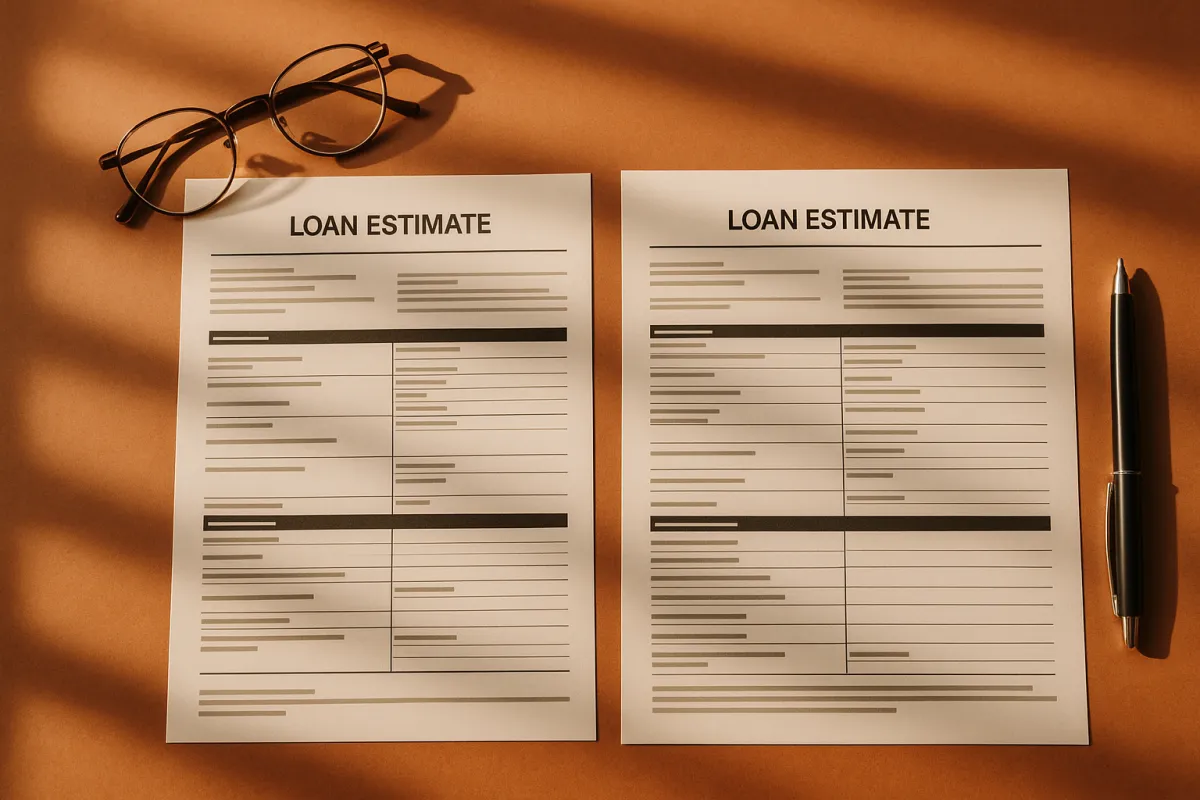
The Loan Estimate is where a no-closing-cost refinance stops being a sales phrase and becomes numbers you can check. Every lender must give you this standardized form within three business days of your application, and it shows lender credits explicitly (the CFPB’s Loan Estimate explainer walks through each page). On page two, a lender credit appears as a negative number that offsets your closing costs, and page one shows the interest rate that credit bought. Together they tell you exactly what the no-cost structure is costing you in rate.
To read it, compare two Loan Estimates from the same lender: one structured traditionally and one structured no-closing-cost. The no-cost version will show a higher rate and a lender credit that zeroes out or nearly zeroes out your costs. The difference in the monthly payment between the two forms is the premium you are paying, and the credit amount is the cost you are avoiding. Divide one by the other and you have your break-even without any guesswork.
This is why you should never accept a no-closing-cost quote on the strength of the phrase alone. Ask for it in writing on a Loan Estimate, and ask for the traditional version alongside it. Our rundown on reading a Loan Estimate walks through where each figure sits on the form, and once you can find the rate and the credit, the whole tradeoff is legible in about a minute.
Questions to ask lenders about a no-closing-cost refinance
A handful of direct questions cut through the marketing and get you the numbers you need. Ask them of every lender, because the answers are what you actually compare, not the headline rate. The first and most important: what is my rate with the costs paid in cash, and what is my rate with a no-closing-cost structure? That single comparison reveals the rate premium at the heart of the deal.
Next, ask which mechanism the no-cost quote uses. Is this a lender credit that raises my rate, or are the costs being rolled into my loan balance? The two behave differently, and a lender should be able to tell you plainly. Then ask for the monthly payment under each structure, and for the total lender credit amount, so you can run the break-even yourself rather than trusting a verbal summary. Finally, ask whether a partial version is available, where a smaller credit covers part of the costs for a smaller rate bump.
Two more questions protect you from surprises. Ask whether the quoted no-closing-cost structure truly covers all third-party fees, including the appraisal and title work, or only the lender’s own charges, because some quotes leave a few items for you to pay. And ask how long the rate lock holds, since the whole comparison assumes both structures are priced in the same rate environment. A lender who answers these clearly is one you can trust with the deal.
How to compare two no-cost quotes fairly
Comparing two no-closing-cost quotes against each other is trickier than comparing traditional ones, because the cost is hidden in the rate rather than shown as a fee. You cannot just look for the lowest closing costs, since both quotes show roughly zero. Instead, the rate becomes almost the entire comparison, and the lower-rate no-cost quote is generally the better one, assuming both genuinely cover the same set of fees.
The catch is that word same. One lender’s no-closing-cost quote might cover every fee, while another’s covers only the lender charges and quietly leaves you to pay the appraisal and title. To compare fairly, confirm exactly which costs each credit absorbs, then compare the rates on quotes that cover the identical scope. If one quote leaves fees uncovered, add those back mentally before you judge the rate, or the comparison is rigged in that lender’s favor.
It also helps to lock the loan terms flat across quotes: same balance, same term, same rate-lock window. Because a no-closing-cost rate reflects the credit baked into it, a difference in term or timing can move the rate for reasons that have nothing to do with the lender’s competitiveness. Hold everything else constant and let the rate be the variable. Our step-by-step refinance rundown covers the shopping process that surrounds this comparison.
Partial no-closing-cost refinances
The choice is not strictly all or nothing, and the partial version is often the most sensible landing spot. Instead of a credit that covers every dollar of cost, you take a smaller credit that covers part of the bill and accept a smaller rate bump, or you pay some costs in cash and finance or credit the rest. This lets you tune the structure to exactly how much cash you have and how long you expect to stay, rather than snapping to an extreme.
Consider a borrower with $3,000 available but $6,000 in costs. A full no-closing-cost structure would push their rate up more than necessary, while paying fully upfront is out of reach. A partial structure lets them put their $3,000 toward the costs and cover the remaining $3,000 with a credit, taking a rate premium roughly half the size of the full version. They get most of the rate benefit with the cash they actually have, which is often the best real-world outcome.
To use this, ask the lender to price several credit levels, not just zero and full. Seeing how the rate moves as the credit grows lets you find the point where the rate premium stops being worth the cash it saves for your horizon. The partial path rewards borrowers who treat the decision as a dial rather than a switch, and most lenders can quote it if you ask.
No-closing-cost refinance and your break-even horizon
Every thread in this breakdown ties back to one number: your break-even horizon, the point where the no-cost path stops being cheaper. Because it is a single division, closing costs avoided over extra monthly payment, it is easy to compute for any quote and easy to test against your honest expected time in the loan. If your horizon is clearly shorter than the break-even, go no-cost. If it is clearly longer, pay upfront. If it is close, either choice is defensible and the deciding factor becomes your cash and your certainty.
The horizon is also where you should be most careful, because it is the input you control least and predict worst. A conservative estimate protects you: if you assume you will keep the loan a bit longer than you expect, you bias toward the choice that is cheaper on a long hold, which limits the damage if you end up staying. If you are genuinely torn, remember that the no-cost path caps your upfront risk, while the upfront path caps your long-run cost.
This is the same horizon logic that governs whether to refinance at all, which is why the two decisions belong together. A refinance that only pays off after several years is a poor fit for a short stay regardless of how you handle the costs, and our break-even breakdown works through that larger question in full. Layer this article’s cost-handling choice on top of that decision, and you have the complete picture. The companion below computes your horizon and its verdict as you adjust the inputs.
Common mistakes with no-closing-cost refinances
The mistakes cluster around the same misunderstanding, treating the word free as if it were literal. The first and biggest error is choosing a no-closing-cost refinance for a long-term home purely to avoid writing a check at closing. That borrower saves a few thousand dollars once and pays it back many times over through the rate. If you know you are staying, the upfront cost is almost always the cheaper path.
A second mistake is failing to get the comparison in writing. Homeowners hear no closing costs and stop asking questions, never learning the rate premium they accepted or the break-even it implies. Always request both structures on Loan Estimates and run the division. A third mistake is comparing two no-cost quotes on rate alone without confirming they cover the same fees, which lets a lender look cheaper by quietly leaving costs for you to pay.
A fourth error is misjudging the horizon in the optimistic direction, assuming an early exit that never comes and locking in the more expensive structure for a long hold. And a fifth is ignoring the partial option, forcing an all-or-nothing choice when a middle path would have fit better. Each mistake is avoidable with the same habit: strip out the word free, get the numbers in writing, and check them against a conservative estimate of your time in the loan.
How this fits the broader refinance decision
A no-closing-cost refinance is not a separate kind of loan; it is a way of handling the costs of an ordinary refinance, and it only matters once you have already decided a refinance is worth doing. The first question is always whether refinancing at all clears your break-even given the rate improvement you can get. Only after that answer is yes does the how-to-pay-the-costs question in this breakdown come into play.
Seen that way, this decision is the last mile of a longer process. You confirm the new rate meaningfully lowers your payment, you check that you will hold the loan long enough for the refinance itself to pay off, and then you choose how to handle the closing costs based on your cash and your horizon. The cost-handling choice can flip a marginal refinance from worthwhile to not, or vice versa, which is why it deserves the same care as the rate itself.
It also interacts with the other levers in a refinance. Shopping several lenders lowers both the rate and the costs, which shrinks the premium a no-closing-cost structure has to charge. Skipping unnecessary discount points keeps the comparison clean. Our full refinance cost breakdown and step-by-step rundown cover those surrounding decisions, and this article slots into them as the specific question of who pays the fees and when.
A no-closing-cost refinance checklist
Before you choose, run this short checklist so the decision rests on numbers rather than a phrase. Confirm you actually want to refinance in the first place, meaning the new rate lowers your payment enough to clear the refinance’s own break-even. Get a Loan Estimate for both the traditional and the no-closing-cost structure from each lender, so you can see the rate premium and the credit in writing.
Compute your break-even by dividing the closing costs you would avoid by the extra monthly payment the no-cost structure adds. Compare that break-even against a conservative estimate of how long you will keep the loan. If your horizon is shorter, lean no-cost; if longer, lean upfront; if close, let your cash position and certainty decide. Ask which mechanism each no-cost quote uses, lender credit or rolled-in balance, and confirm the credit covers all fees, not just the lender’s own.
Finally, ask whether a partial structure fits better than an all-or-nothing one, especially if you have some cash but not all of it. Lock the loan terms flat across quotes so the rate is the only variable, and use the break-even calculator and the companion on this page to test each horizon before you commit. Work the list and you will choose the structure that fits your plan rather than the one with the most appealing name.
How to refinance a mortgage without closing costs
There are only two mechanisms behind any no-closing-cost offer, and knowing which one you are being offered is the whole of the analysis.
A lender credit funded by a higher rate. The lender pays your closing costs and recovers them through the interest rate over the life of the loan. Nothing is waived; the cost is converted into a slightly higher payment every month.
Costs rolled into the loan balance. You finance the closing costs rather than paying them at the table, so the balance rises and you pay interest on the difference for as long as you hold the loan.
Both are legitimate, and both suit a specific situation: when you expect to sell or refinance again within a few years, paying costs upfront that you never recover makes little sense, and the higher rate applies for only a short period.
Both are poor value when you intend to keep the loan for a long time, because the rate premium or the added balance compounds well past what the costs would have been.
The way to compare them is to ask the same lender for two quotes: one with costs paid at closing and one with a lender credit covering them. The difference in rate, converted into a monthly figure and divided into the closing costs, gives the number of months at which paying upfront would have been cheaper. Our breakdowns on what refinancing costs and when refinancing pays off cover that break-even calculation.
The bottom line
A no-closing-cost refinance does not remove your closing costs; it relocates them, either into a higher interest rate through a lender credit or into a larger loan balance you finance over time. Free is the wrong word for it. The right word is financed, and like any financing it is a good deal in some hands and a poor one in others. The deciding factor is almost never the rate on the page; it is how long you will keep the loan. Divide the illustrative $6,000 of costs you would avoid by the illustrative $98 a month the no-cost structure adds, land on a break-even around 61 months, and compare that to your honest horizon. Shorter than the break-even, or short on cash, and the no-closing-cost path is the smart move. Longer than the break-even, with cash to spare, and paying upfront is cheaper by a widening margin. Get both structures in writing on a Loan Estimate, confirm which mechanism each uses, and run the division yourself, because the only quote that matters is the one measured against your own time in the home.
A note in plain terms: this breakdown maps how a no-closing-cost refinance is built and priced, but it cannot see your loan, your lender’s rate sheet, your state’s fees, or how long you will truly keep the home, and it is educational material, not mortgage, financial, or tax advice. Every figure here, the $300,000 loan, the 6.50 and 6.99 percent rates, the $6,000 of costs, the $98 monthly premium, and the roughly 61-month break-even, is a consistent teaching example rather than a quote, and your real numbers will differ by lender, loan type, and the week you lock. Before you choose a structure, put an actual Loan Estimate for both the traditional and the no-closing-cost version in front of a licensed mortgage professional, confirm which mechanism each uses and which fees each credit covers, and let a qualified adviser weigh your specific horizon and cash position.
Frequently asked questions
What is a no-closing-cost refinance?
A no-closing-cost refinance is a refinance where you do not pay the closing costs out of pocket at the closing table. The costs themselves do not disappear; the lender covers them for you and recovers the money one of two ways. Most commonly the lender gives you a credit toward the fees in exchange for a slightly higher interest rate, so you repay the cost through a higher payment for as long as you hold the loan. Less commonly, the costs are added to your new loan balance, so you finance them over the life of the loan. Either way, the phrase means no cash upfront, not free.
Is a no-closing-cost refinance really free?
No. A no-closing-cost refinance is one of the more misleading names in mortgages, because nothing about it is free. The lender is a business and will not absorb your closing costs out of goodwill; it recovers them, with a margin, through the higher rate or the larger balance it gives you in return. On an illustrative $300,000 refinance with about $6,000 of costs, a no-closing-cost structure might raise your rate by roughly half a percentage point, which can add an illustrative $98 to your monthly payment. Over a long hold that higher payment quietly costs more than the fees it replaced. The right way to read it is a financing choice, not a discount.
How does the higher interest rate pay for the closing costs?
When you take a lender credit to cover your closing costs, the lender agrees to pay those fees at closing and prices a higher interest rate to earn the money back over time. The higher rate raises your monthly payment by a small amount, and that extra payment, collected month after month, repays the credit and then some. On an illustrative $300,000 loan, moving from a 6.50 percent rate to a 6.99 percent rate might lift the payment from about $1,896 to about $1,994, an extra $98 a month. Multiply that by the months you keep the loan and you can see when the lender has been repaid and when it is ahead. Confirm the exact rate-for-credit tradeoff on your own Loan Estimate.
When does a no-closing-cost refinance make sense?
A no-closing-cost refinance tends to win when you will not hold the loan long. If you expect to sell the home or refinance again within a few years, you may never keep the higher rate long enough for the extra interest to catch up to the closing costs it replaced, so avoiding the upfront bill is a genuine saving. It also helps when you simply do not have the cash to pay several thousand dollars at closing, since it lets you capture a lower rate now without draining your savings. The shorter your expected time with the loan, the stronger the case. Run your own horizon through the companion on this page before deciding.
When does a no-closing-cost refinance cost more?
It costs more over a long hold. Because the higher rate applies to every payment for as long as you keep the loan, a homeowner who stays put for many years pays that premium hundreds of times, and the total can far exceed the illustrative closing costs it replaced. On the illustrative $300,000 example, an extra $98 a month held for the full 30 years adds up to an illustrative $35,280, versus the roughly $6,000 of upfront costs you avoided. Past the break-even point, roughly 61 months in that example, paying the costs upfront would have been the cheaper choice. If you are confident you will keep the loan long term and you have the cash, upfront usually wins.
What is the difference between a lender credit and rolling costs into the loan?
They are two different mechanisms that both spare you cash at closing. With a lender credit, your loan balance stays the same but your interest rate goes up, so you pay the cost through a higher rate on the original balance. With rolling costs in, your rate stays the same but your loan balance grows by the amount of the fees, so you pay the cost as extra principal and interest on a larger loan. A lender credit usually produces a bigger monthly difference per dollar of cost, while rolling in spreads a smaller increase across a bigger balance. Ask the lender to show you both, because the labels get used loosely and only the numbers tell you which is cheaper for your situation.
How do I compare a no-closing-cost refinance with a traditional one?
Get both quotes in writing and compare them on the same horizon. Ask each lender for a Loan Estimate showing the traditional version, where you pay the costs and take the lower rate, and the no-closing-cost version, where you skip the costs and take the higher rate. Note the monthly payment difference and divide the closing costs you would avoid by that difference to find your break-even in months. If you expect to keep the loan longer than the break-even, the traditional refinance is cheaper; if shorter, the no-closing-cost one is. The comparison only works when both quotes use the same loan amount, term, and rate lock timing.
Can I do a partial no-closing-cost refinance?
Yes, and it is a common middle path. Rather than covering all your costs with a lender credit, you can take a smaller credit that pays part of the bill and accept a smaller rate bump, or you can pay some costs in cash and finance the rest. This lets you tune the tradeoff to your cash on hand and your expected time in the loan instead of choosing an all-or-nothing structure. Many borrowers who are short a few thousand dollars but not entirely out of cash land here. Ask the lender to price several credit levels so you can see how each one moves your rate and payment before you pick one.

Hamza Hai is the editor of RefiNook. She holds an MBA and reviews the site's articles against our editorial standards, checking that every figure is labelled for what it is, that nothing is presented as verified fact without a source the reader can check, and that the writing stays useful to a non-specialist.