
What's on this page
- What a refinance actually costs
- The 2 to 6 percent headline range
- Where your refinance fees go
- Lender fees: application, origination, underwriting
- Third-party fees: appraisal, title, and the rest
- Government recording and transfer fees
- Prepaids and the escrow deposit
- Discount points, if you choose them
- Which fees are negotiable and which are fixed
- The no-closing-cost refinance
- Rolling costs into the loan versus paying upfront
- How cost meets break-even
- Streamline refinances and lower-cost paths
- Lender credits explained
- How to shop and compare Loan Estimates
- The appraisal waiver possibility
- Junk fees worth challenging
- How cash-out adds to the cost
- A worked example: a $300,000 refinance itemized
- The bottom line
Short answer: Refinancing a mortgage commonly costs an illustrative 2 to 6 percent of the loan amount, roughly $6,000 to $18,000 on a $300,000 loan. The bill splits into three families: lender fees, third-party services such as the appraisal and title work, and prepaids plus escrow, which are your own money moved forward. Lender fees and shoppable services are negotiable; government recording charges are fixed. A no-closing-cost refinance converts the cost into a higher rate.
Almost everyone shopping for a refinance fixes on a single number, the new interest rate, and treats everything else as paperwork. That is a costly habit, because the rate is only half of the deal. The other half is what you pay to get that rate, and a refinance is not free: it carries its own closing costs, commonly an illustrative 2 to 6 percent of the loan amount, and those costs decide whether a lower rate actually leaves you ahead. A refinance that saves you $150 a month is a good deal at $4,000 of cost and a poor one at $14,000, even though the rate is identical.
This breakdown itemizes the whole bill. It gives you the headline range and where it comes from, then walks each fee family one at a time: the lender charges, the third-party services, the government fees, and the prepaids that are really just your own money moved forward. It marks which lines are negotiable and which are fixed, explains the no-closing-cost option and the tradeoff hiding inside it, weighs paying upfront against rolling the costs into the loan, and ties the whole thing back to the break-even math that decides if a refinance pays. You can price your own refinance as you go in the break-even calculator, and the companion on this page itemizes your specific number section by section.
Key takeaways
- A refinance commonly costs an illustrative 2 to 6 percent of the loan, roughly $6,000 to $18,000 on a $300,000 loan, and the figure scales mostly with loan size.
- The bill splits into three families: lender fees, third-party services, and prepaids plus escrow, and only the first two are truly costs.
- Lender fees and shoppable services are negotiable; government recording and transfer charges are fixed and will not move.
- A no-closing-cost refinance does not erase the cost, it converts it into a higher rate you pay every month for as long as you hold the loan.
- The cost and the break-even are one question, not two: a higher cost pushes your payoff point further out, so both must be read together.
What a refinance actually costs
A refinance replaces your existing mortgage with a new one, and because it is a brand new loan, it triggers most of the same closing costs you paid when you first bought the home. That surprises people, who reasonably assume that since the house has not changed hands, the paperwork should be light. It is not. The lender still verifies your income and credit, the property still usually needs a value, the title still needs to be checked and insured, and the county still charges to record the new lien. All of that costs money.
The total lands in a fairly predictable band. Across most conventional refinances, closing costs run an illustrative 2 to 6 percent of the loan amount. On a $300,000 loan that is roughly $6,000 to $18,000, a wide spread that reflects real differences in state taxes, lender pricing, and whether you buy discount points. The number is not random, though. It is the sum of a dozen or so specific line items, each of which you can see, question, and in several cases reduce.
The rest of this breakdown takes those line items apart. The goal is not to memorize a fee schedule but to understand the shape of the bill: which charges are large, which are negotiable, which are simply your own money, and which ones deserve a hard look before you sign. Once you can read a Loan Estimate the way a lender does, the 2 to 6 percent stops being a mystery and becomes a set of decisions.
The 2 to 6 percent headline range
It helps to see why the range is so wide, because the spread is not noise, it is structure. Some refinance costs scale directly with the size of the loan. Title insurance, discount points, and the percentage-based portion of certain lender fees all grow as the loan grows, so a $600,000 refinance carries larger dollar costs than a $200,000 one even at the same percentage. Other costs are nearly flat regardless of loan size: the credit report, the recording fee, and often the appraisal cost about the same on a small loan as a large one.
That mix is why the percentage itself drifts. On a small loan the flat fees loom large and can push the total toward the high end of the range as a percentage. On a large loan those same flat fees shrink into insignificance and the percentage can settle lower. The chart below sizes the dollar cost across three loan amounts at an illustrative 3 percent, which is a reasonable midpoint for a straightforward rate-and-term refinance.
Illustrative refinance cost by loan size
Total closing costs at an illustrative 3 percent of the loan. Longer bar means a bigger bill.
The dollar cost rises almost in step with the loan because the largest single charges, title insurance and any points, are percentage-based. The percentage itself can drift lower on bigger loans as flat fees fade, but the raw bill grows. These figures are illustrative sketches, not quotes.
Read the chart as a warning against thinking in percentages alone. A homeowner refinancing a $600,000 balance who hears “only 3 percent” is still looking at an illustrative $18,000 bill, a large sum that needs a real payoff to justify. Percentages feel small; the dollars are what you actually pay. Size your own loan in the break-even calculator and the abstraction becomes a concrete number you can weigh.
Where your refinance fees go
Before pricing individual lines, it is worth stepping back to see the shape of the whole bill, because refinance costs are not one undifferentiated pile. They fall into three families, and knowing which family a charge belongs to tells you almost everything about whether you can move it. Lender fees are what the lender charges for its own work. Third-party fees pay outside companies the lender coordinates on your behalf. Prepaids and escrow are your own money set aside for future insurance, taxes, and interest.
Where your refinance dollars go
Illustrative split of a typical refinance bill across the three cost families. Shares sum to 100.
Only the first two slices are true costs of the refinance; the third is your own money moved forward. The exact split shifts with your state and lender, but the ordering holds: lender and third-party charges are the levers you can actually pull. These proportions are illustrative.
The split matters because your leverage lives almost entirely in the first two slices. The lender family is where negotiation happens. The third-party family is where shopping happens. The prepaid family is where nothing happens, because there is nothing to negotiate about moving your own money into an escrow account. When someone tells you they saved thousands on a refinance, they trimmed the first two slices, never the third. The next sections take each family in turn.
Lender fees: application, origination, underwriting
Lender fees are the charges the lender levies for originating your loan, and they are the most negotiable part of the whole bill. The origination fee is the headline item, often quoted as a percentage of the loan or a flat sum, and it compensates the lender for processing and closing the loan. Alongside it you may see an application fee, a processing fee, and an underwriting fee, which are sometimes bundled into the origination charge and sometimes listed separately.
Because these fees are the lender’s own price for its work, they respond to competition. A lender that wants your business will often waive, reduce, or credit some of these charges, especially when you arrive with a competing Loan Estimate showing a lower total. This is the single most productive place to push. The lender cannot lower your county’s recording fee, but it can absolutely reconsider its own origination charge if a rival is hungrier for the loan.
Watch for fees that are really the same charge under different names. A loan might list a processing fee, an administration fee, and a document preparation fee that together do the work one origination fee does elsewhere. The names matter less than the total in the lender section, so compare that subtotal across quotes rather than any single line. On an illustrative $300,000 refinance, the lender family often lands at a sizable slice of the bill, and it is the slice where a sharp borrower recovers the most.

Third-party fees: appraisal, title, and the rest
The second family pays outside companies for services the lender requires but does not perform itself. The appraisal is often the largest single item here, an illustrative $400 to $700 to have a licensed appraiser value the home and confirm the loan is well secured. The credit report fee is small, usually well under $100, and covers pulling your credit from the bureaus. These are ordered by the lender but performed by others, which is why they show up as their own charges.
Title is the heavyweight of this family. A title search checks public records to confirm you own the home free of undisclosed liens, and title insurance protects the lender against a claim that surfaces later. On a refinance you typically pay for a new lender’s title policy, and because it is priced off the loan amount, it is one of the costs that scales with loan size. Depending on your state you may also pay an attorney or settlement agent to conduct the closing, a charge that varies widely by region.
The important feature of the third-party family is that much of it is shoppable. Federal rules divide these services into ones the lender selects and ones you are allowed to choose, and the Loan Estimate labels them. For the shoppable services, primarily title and settlement, you can bring your own provider and pocket the difference. On an illustrative refinance the third-party slice runs to a meaningful amount, and the shoppable portion of it is real money you can influence.
Government recording and transfer fees
The third source of true cost is the government, and unlike the first two families, this one does not negotiate. When you refinance, the county records the new mortgage lien in the public record, and it charges a recording fee to do so. The amount is set by local schedules and is usually modest, often in the low hundreds of dollars, though it varies by county and by the number of pages in the documents.
Some states and localities also levy a transfer tax or a mortgage tax on refinances, and where these apply they can be significant. A handful of jurisdictions tax the mortgage amount at a set rate, which on a large loan turns a formality into a meaningful line item. Others exempt refinances from transfer taxes entirely or offer a credit for a prior tax already paid, so the charge depends heavily on where the property sits.
There is no strategy for government fees beyond knowing they exist and cannot be trimmed. They are fixed inputs to your total, the same for every lender you shop, which is actually useful: because they do not change across quotes, they are not where you compare. When you line up two Loan Estimates, the recording and transfer charges should be nearly identical, so any difference in your total comes from the lender and third-party families instead.
Prepaids and the escrow deposit
Here is the part of the bill that looks like a cost but mostly is not. Prepaids and the initial escrow deposit make up a large chunk of the cash you bring to a refinance closing, yet almost none of it is a fee. It is your own money, collected early and set aside for expenses you would owe anyway. Confusing this money with true costs is the most common way homeowners overestimate what a refinance actually costs them.
Prepaid interest covers the interest on your new loan from the closing date to the end of that month, since your first regular payment does not arrive until the following month. The initial escrow deposit funds the account the servicer uses to pay your property taxes and homeowners insurance, seeded with a few months of each so the account never runs dry. You may also prepay a portion of the first year’s homeowners insurance. None of this enriches the lender; it is timing.
When you refinance, your old loan’s escrow account is usually refunded to you a few weeks after closing, which partly offsets the new escrow deposit you just funded. That refund is easy to forget, and it means the escrow line on your Loan Estimate overstates the net cash the refinance really costs you. On an illustrative bill the prepaid and escrow slice runs to a meaningful amount, and it is the one part of the total you should mentally set aside when judging whether the refinance is worth it, because it is your money, not a fee.
Discount points, if you choose them
Discount points are optional, which makes them different from every other line so far. A point costs 1 percent of the loan and buys a lower interest rate for the life of the loan, so choosing to pay points deliberately increases your closing costs today in exchange for a smaller payment every month. If you see points on a Loan Estimate you did not ask for, that quote is buying down the rate to look more competitive, and you are paying for it in the cost column.
Because points are elective, they should be pulled out of the cost conversation and judged on their own terms. Paying an extra illustrative $3,000 for a point is only worth it if you keep the loan long enough for the monthly saving to repay that $3,000 and then some. The arithmetic is identical to the analysis in our mortgage points breakdown, which walks through exactly when the buydown pays and when it does not.
The practical caution is to compare quotes at the same number of points, or better, at zero points, so you are comparing the actual cost of the loan rather than a rate that has been purchased down. A quote showing a low rate and a high cost may simply have baked points into the fees. Strip the points out, compare the underlying rate and the remaining costs, then decide separately whether buying the rate down is worth it for your horizon.
Which fees are negotiable and which are fixed
Now the families pay off, because the single most useful skill in refinancing is knowing which lines will move and which will not. Push on the wrong ones and you waste effort; ignore the right ones and you leave money behind. The rule of thumb follows the three families almost exactly.
Lender fees are negotiable. Origination, application, processing, and underwriting charges are the lender’s own price, and a competitive Loan Estimate in hand is the strongest lever you have to trim them. Shoppable third-party services are movable too: for title and settlement, you can bring a cheaper provider and keep the savings. Non-shoppable third-party services, like the appraisal the lender must order, are harder to influence but still vary by lender relationship. Government recording and transfer charges are fixed, identical across every quote. Prepaids and escrow are your own money and simply are not negotiable, only refundable later.

The tactic that follows is straightforward. Get at least two or three Loan Estimates, line up the lender sections, and use the lowest as leverage on the others. Then attack the shoppable services separately. Leave the fixed charges alone, because no amount of pushing changes what your county charges to record a lien. On an illustrative $300,000 refinance the negotiable and shoppable lines are a real fraction of the illustrative total, which is why shopping pays.
The no-closing-cost refinance
The phrase no-closing-cost refinance is one of the most misunderstood in mortgages, because it is not what it sounds like. The costs do not disappear; they change form. In a no-closing-cost refinance the lender pays your closing costs on your behalf through a lender credit, and in return you accept a slightly higher interest rate. You have not avoided the cost, you have financed it through the rate, spreading it across every monthly payment for as long as you hold the loan.
This is the rate buydown mechanism running in reverse. Where discount points let you pay cash today to lower your rate, a lender credit lets you accept a higher rate today to avoid paying cash. The lender is happy to make this trade because the higher rate earns back the credit and then some over a normal holding period. Our rate buydown breakdown walks through the same cash-for-rate exchange from the other direction, and the logic is symmetric.
Whether the no-closing-cost path wins comes down to how long you keep the loan. If you expect to sell or refinance again within a few years, you may never hold the higher rate long enough for the extra interest to catch up to the illustrative closing costs it replaced, so the credit is a genuine win. If you plan to keep the loan for many years, the higher rate quietly costs you more than the upfront fees would have, and paying the costs directly is cheaper. It is the same horizon question that governs every refinance decision.
Rolling costs into the loan versus paying upfront
Close cousin to the no-closing-cost refinance is the option to roll the costs into the loan balance. Here the rate does not change; instead the closing costs are added to the amount you borrow, so you finance them rather than pay cash at closing. Your payment rises a little because the balance is a little larger, and you have preserved your cash for other uses. It is a common choice, and like every choice in this breakdown it carries a tradeoff.
The tradeoff is interest. Every dollar of cost you roll into the loan now accrues interest for the life of the loan, so the true cost of financing your closing costs is more than the closing costs themselves. On an illustrative refinance the costs come to a set amount if you pay them at the table. Roll that same amount into a thirty-year loan and, once the interest on it is counted, you can end up repaying appreciably more over the full term. Paying upfront is cheaper in total; rolling in is easier on your cash today.
Neither answer is universally right. If your cash has a better use, an emergency fund, higher-interest debt, an investment you believe in, keeping it and rolling the costs in can make sense despite the extra interest. If you have the cash to spare and plan to hold the loan a long time, paying upfront avoids years of interest on the fees. Ask your lender to show the Loan Estimate both ways and compare the two payments and the two totals side by side before you decide. You can model both in the break-even calculator.
How cost meets break-even
Everything in this breakdown converges on one number: the break-even, the point where the money you save each month has finally repaid what the refinance cost. Cost and savings are not two separate questions, they are the numerator and denominator of a single fraction. The cost sits on top; the monthly saving sits on the bottom; the result is how many months you must keep the loan before the refinance is worth having done.
That is why a lower cost is not just nice, it directly shortens your payoff window. If a refinance costs an illustrative amount and lowers your payment by $200 a month, break-even sits an illustrative number of months out, and the refinance only pays if you keep the loan past that point. Trim the cost through negotiation and shopping and the break-even pulls closer, widening the margin of safety. Inflate the cost with unnecessary points or junk fees and the break-even drifts out until the refinance may never pay at all.
Our refinance break-even breakdown is the companion piece to this one: it takes the cost you have itemized here and turns it into a timeline. Read the two together and you have the whole picture, the price of the refinance and the horizon over which it earns that price back. The companion on this page recomputes your own recoup window live, so you can watch it move as you change the cost assumptions. And when the numbers say go, our seven-step refinance walkthrough shows where each of these costs surfaces in the process, from the Loan Estimate you shop to the Closing Disclosure you sign.
Streamline refinances and lower-cost paths
Not every refinance carries the full bill. Several government-backed loan programs offer streamline refinances, stripped-down processes designed to lower your rate with far less cost and paperwork than a standard refinance. Because they exist to help existing borrowers benefit from lower rates, they cut out much of the underwriting and often the appraisal, which are two of the larger line items on a conventional refinance.
The common thread across streamline programs is reduced documentation. They typically skip or simplify the income verification, frequently waive the appraisal, and move faster because the lender already holds much of your file from the original loan. Removing the appraisal alone strips an illustrative $400 to $700 from the bill, and skipping full underwriting can trim the lender fees as well. The catch is eligibility: streamlines are limited to specific loan types and usually require that the refinance produce a real benefit, such as a lower rate or payment.
If your current mortgage is a government-backed loan, asking whether a streamline is available is one of the highest-value questions you can pose, because it can shrink the very costs this breakdown has been itemizing. Even outside formal streamline programs, some lenders offer their own lower-cost refinance products to retain existing customers. The point is to ask, because the standard refinance is not the only path, and the cheaper paths change the whole cost calculation.
Lender credits explained
Lender credits deserve their own section because they are the mirror image of discount points and the engine behind the no-closing-cost refinance. A lender credit is money the lender applies toward your closing costs in exchange for accepting a higher interest rate. Where a point is cash you pay to lower the rate, a credit is cash the lender gives you to raise it. Both appear on the Loan Estimate, and both are tools for shifting cost between today and the future.
Used deliberately, credits are useful. A borrower who is short on cash at closing, or who expects to hold the loan only briefly, can take a lender credit to cover some or all of the costs, accepting a modestly higher rate as the price. Because the extra rate costs a little each month while the credit saves a lump sum now, the trade favors shorter holding periods, exactly like the no-closing-cost structure it enables.
The discipline is to price the credit, not just accept it. Ask how much higher the rate goes for a given credit, then compare the monthly cost of that higher rate against the illustrative costs the credit covers. If you will hold the loan long enough for the extra interest to exceed the credit, the credit costs you money; if not, it saves you money. Lenders present credits as a convenience, but they are a calculated trade, and you should run the numbers before taking one.
How to shop and compare Loan Estimates
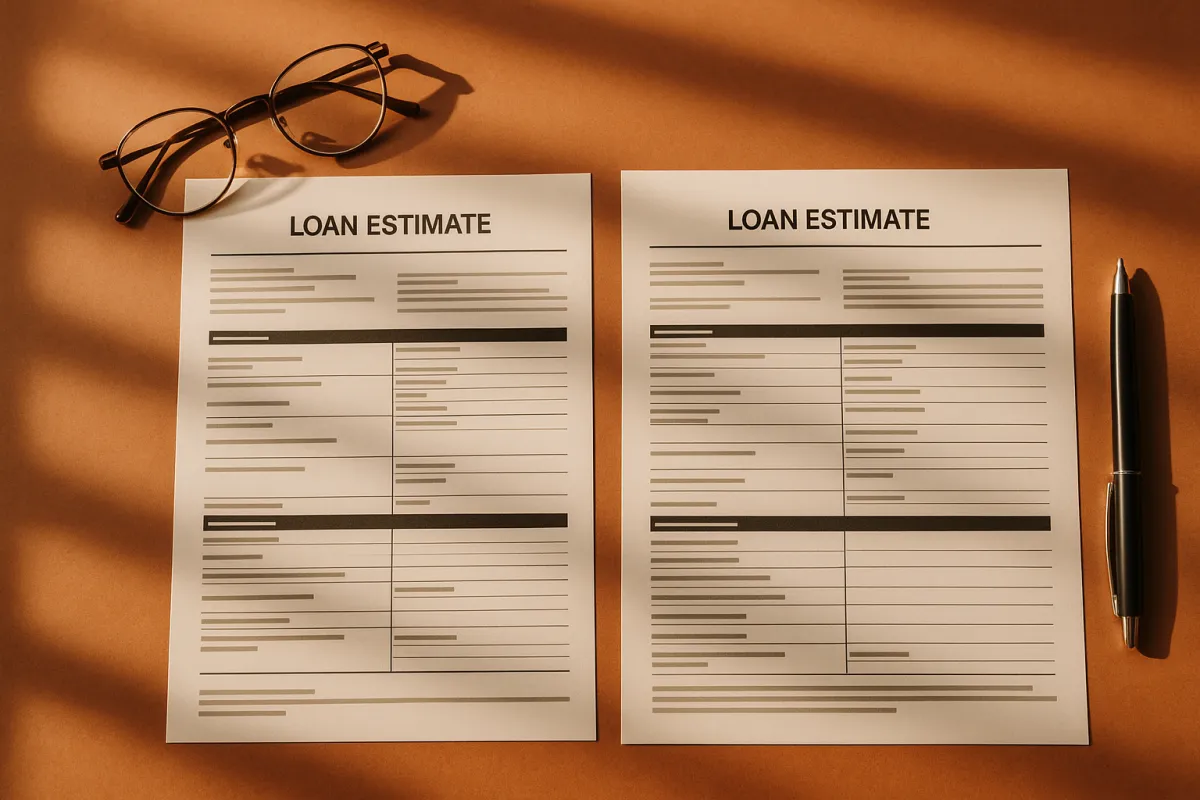
The Loan Estimate is your most powerful tool, and it exists precisely so you can shop. Every lender must give you one within three business days of your application, and every one uses the same format with the charges in the same order, which makes true side-by-side comparison possible for the first time in mortgage history. The homeowners who overpay for a refinance are almost always the ones who took the first quote without comparing.
Compare the right things. The interest rate and the annual percentage rate sit at the top, and the APR is useful because it folds many of the costs into the rate for a rough combined comparison. Below that, page two itemizes the charges into the same families this breakdown has covered. Line up two or three Loan Estimates and compare the lender-fee subtotals, then the shoppable services, then the totals. Because the government fees are fixed and the prepaids are your own money, the meaningful differences will show up in the first two families.
The most valuable move is to collect several estimates within a short window so the quotes reflect the same rate environment, then use the lowest as leverage on the rest. A lender with a higher total will often match a competitor to win the loan, especially on the negotiable lender fees. On an illustrative $300,000 refinance the spread between a shopped and an unshopped bill can be substantial, which is the entire reason the Loan Estimate is standardized. Shopping is not busywork; it is where the savings are.
The appraisal waiver possibility
The appraisal is one of the more avoidable costs, and it is worth asking about specifically. When your loan qualifies, the lender may grant an appraisal waiver, accepting an automated valuation of your home instead of sending a human appraiser. That removes an illustrative $400 to $700 from your bill and shaves days off the timeline, since waiting for an appraisal is often the slowest step in closing.
Waivers are not guaranteed and you cannot demand one, but they follow a pattern. They are more likely when you have substantial equity, a strong credit profile, and a home in an area with plenty of recent comparable sales that the automated models can lean on. Properties that are unusual, in thin markets, or refinancing near the edge of the lender’s value limits are more likely to need a full appraisal. The lender runs your loan through an automated system that decides eligibility.
The move is simply to ask before the appraisal is ordered whether your loan is eligible for a waiver. It costs nothing to ask and can save several hundred dollars if the answer is yes. Combined with a streamline program, which often waives the appraisal by design, this is one of the cleaner ways to pull a real line item out of the illustrative total without any tradeoff at all.
Junk fees worth challenging
Not every charge on a Loan Estimate is legitimate padding-free, and some lenders inflate the total with fees that are vague, duplicated, or marked up well beyond their real cost. These are often called junk fees, and while the term is loose, the pattern is recognizable: charges with fuzzy names, several fees that seem to describe the same work, or third-party costs that look higher than the service should run. Spotting them is part of reading the bill critically.
Look for duplication first. A quote that lists a processing fee, an administrative fee, and a document preparation fee may be charging three times for one bundle of work, when a competing lender folds it all into a single origination line. Look next at any charge labeled miscellaneous, or a courier or wire fee that seems out of proportion. None of these are automatically improper, but each deserves a question, and a lender that cannot explain a fee clearly is a lender you can push on it.
The way to challenge junk fees is not to argue line by line in isolation but to compare totals across Loan Estimates. If one lender’s lender-fee subtotal is meaningfully higher than another’s for the same loan, the difference is often padding, and naming it usually gets it trimmed. You do not need to win every line; you need the lowest defensible total. Every dollar you strip from the illustrative bill directly shortens your break-even and improves the deal.
How cash-out adds to the cost
A cash-out refinance, where you borrow more than you currently owe and take the difference in cash, changes the cost picture in two ways worth understanding before you choose it. The mechanics of the closing costs are the same as a rate-and-term refinance, the same families, the same line items, but the dollar totals are larger, and there is often a rate premium on top.
The first effect is arithmetic. Because your new loan is bigger, the percentage-based costs are calculated on a larger number. Title insurance, any discount points, and the percentage portion of certain fees all scale up with the loan, so the same illustrative 2 to 6 percent applies to a bigger balance and produces a bigger bill. If you borrow an extra $50,000 in cash, you are paying refinance costs on the whole enlarged loan, not just on your old balance.
The second effect is pricing. Lenders generally view cash-out refinances as slightly riskier, since you are increasing the debt against the home, so they often attach a modestly higher rate or occasional add-on fees to cash-out loans. Neither effect makes a cash-out refinance wrong, but both mean it costs more than a plain rate-and-term refinance of the same home. If the cash you need is modest, it is worth comparing whether a home equity line reaches the same goal at a lower total cost before committing to a full cash-out.
A worked example: a $300,000 refinance itemized
To make the abstract concrete, here is one illustrative refinance built from the families above. Assume a homeowner refinancing a $300,000 balance at an illustrative 3 percent total cost, with no discount points. The point is not that these exact figures will match your quote, they will not, but that you can see how the total assembles from its parts.
The lender family, an illustrative slice of the total, covers the origination, application, and underwriting: the lender’s own price for the loan, and the slice most open to negotiation. The third-party family, another portion of the bill, covers the appraisal, credit report, title search, title insurance, and settlement: the outside services, part of which are shoppable. The prepaid and escrow family, the remaining share, funds prepaid interest and the escrow deposit for taxes and insurance: not a fee at all, but your own money, much of it offset weeks later when your old escrow account is refunded.
Now the payoff logic. Suppose this refinance lowers the payment by an illustrative $200 a month. Divide the illustrative cost by that saving and break-even lands an illustrative number of months out. Keep the loan past that point and the refinance nets money; sell or refinance before it and you paid costs you never recovered. If the homeowner instead rolls the costs into the loan, the amount paid at the table becomes a larger sum repaid over thirty years once interest is counted. Every lever in this breakdown, shopping the lender fees, waiving the appraisal, skipping points, moves one of these numbers, and the companion recomputes all of them for your own loan.
The bottom line
A refinance is not free, and the cost is not a single mysterious number: it is an illustrative 2 to 6 percent of the loan, roughly an illustrative total on a $300,000 loan, assembled from lender fees you can negotiate, third-party services you can partly shop, government charges you cannot move, and prepaids that are really your own money set aside. The no-closing-cost option does not erase the cost, it converts it into a higher rate, and rolling costs into the loan does not erase it either, it converts the upfront cost into a larger interest-laden repayment over the life of the loan. Read the Loan Estimate, compare the lender and third-party families across two or three quotes, ask about an appraisal waiver and a streamline path, and challenge any fee that cannot explain itself. Then set the cost against your break-even, an illustrative number of months out in this example, because the price of the refinance and the horizon over which it pays are one question, not two. A lower rate is only a good deal once you know what you paid to get it.
A closing note in plain terms: this breakdown maps how refinance costs are structured and priced, but it cannot see your loan, your state’s taxes, your lender’s rate sheet, or your closing disclosure, and it is educational material, not mortgage, financial, or tax advice. Every dollar and percentage here, the 2 to 6 percent range, the illustrative total, the family splits, and the break-even figures, is a teaching sketch rather than a quote, and real costs vary by lender, loan type, state, and the week you close. Before you commit to a refinance, put your actual Loan Estimate in front of a licensed mortgage professional, compare it against at least one competing quote, and let a qualified adviser weigh your specific numbers.
Frequently asked questions
How much does it cost to refinance a mortgage?
A refinance commonly runs an illustrative 2 to 6 percent of the loan amount in total closing costs, which on a $300,000 loan is roughly $6,000 to $18,000. The wide range exists because some costs scale with the loan size, such as title insurance and any discount points, while others are close to flat, such as the credit report and recording fees. Where you land inside the range depends on your state, your lender, whether an appraisal is required, and whether you choose to buy down the rate. The single most reliable way to know your own number is to read the Loan Estimate every lender must give you, since it lists every charge in the same order on every quote.
What fees are included in refinance closing costs?
Refinance closing costs group into three families. Lender fees cover the application, origination, and underwriting work, and sometimes discount points if you buy them. Third-party fees cover services the lender orders on your behalf, including the appraisal, credit report, title search, title insurance, and any attorney or settlement charge. Prepaids and escrow are not really fees at all but money set aside for prepaid interest, homeowners insurance, and property taxes. Understanding which family a line belongs to tells you immediately whether it is negotiable, shoppable, or effectively fixed.
Are refinance fees negotiable?
Some are and some are not, and knowing the difference is where the savings live. Lender fees such as origination and application charges are often negotiable, especially if you have competing Loan Estimates, and lenders will sometimes waive or trim them to win the deal. Services you are allowed to shop for, such as title and settlement, can be swapped for a cheaper provider. Government charges like recording and transfer taxes are fixed by your county or state and will not move for anyone. Prepaids and escrow are simply your own money moved forward, so there is nothing to negotiate there beyond the timing.
What is a no-closing-cost refinance and is it really free?
A no-closing-cost refinance is not free; the costs are moved rather than removed. The lender covers your closing costs through a lender credit and pays for it by giving you a slightly higher interest rate, so you trade a lump sum today for a higher payment every month for as long as you keep the loan. This can be the right choice when you expect to sell or refinance again within a few years, because you never hold the higher rate long enough for the extra interest to exceed the costs it replaced. Over a long hold, paying the costs upfront usually wins. The same rate-for-cash tradeoff runs through our rate buydown breakdown in reverse.
Should I roll refinance costs into the loan?
Rolling the costs into the new loan balance means you borrow them instead of paying cash, which preserves your savings but adds interest to every dollar of cost across the life of the loan. On an illustrative $9,000 of costs financed at a typical rate over thirty years, you can end up repaying meaningfully more than $9,000 once interest is counted. The upfront path costs less in total but requires cash at closing, while the rolled-in path costs more over time but keeps your cash. Neither is automatically right; it depends on whether your cash has a better use and how long you will keep the loan. Read the Loan Estimate both ways before deciding.
How do refinance costs affect my break-even point?
Your break-even is the number of months of savings it takes to repay your closing costs, so a higher cost pushes break-even further out and a lower cost pulls it closer. If a refinance costs an illustrative $9,000 and lowers your payment by $200 a month, break-even sits at roughly 45 months, and the refinance only pays off if you keep the loan past that point. This is exactly why the cost of the refinance and the savings from it cannot be judged separately. Our refinance break-even breakdown walks through the timing math in full, and the companion on this page recomputes your own recoup window as you read.
Can I avoid the appraisal fee when refinancing?
Sometimes, through an appraisal waiver. When your loan qualifies, the lender may accept an automated valuation instead of sending a human appraiser, which removes an illustrative $400 to $700 charge from your costs and speeds up closing. Waivers are more common when you have significant equity, a strong credit profile, and a property the data models can value confidently, and they are more available on certain loan types than others. You cannot demand a waiver, but you can ask whether your loan is eligible before ordering the appraisal. Streamline refinance programs on some government-backed loans also reduce or remove the appraisal requirement.
Does a cash-out refinance cost more than a regular refinance?
It usually does, in two ways. First, because you are borrowing more than you currently owe, percentage-based costs such as title insurance and any points are calculated on the larger loan, so the same 2 to 6 percent applies to a bigger number. Second, lenders often price cash-out refinances with slightly higher rates and occasional add-on fees because the larger loan carries more risk. The mechanics of the closing costs are otherwise the same as a rate-and-term refinance, but the dollar totals are larger. If the cash-out portion is small, weigh whether a home equity line might reach the same goal at a lower total cost.

Hamza Hai is the editor of RefiNook. She holds an MBA and reviews the site's articles against our editorial standards, checking that every figure is labelled for what it is, that nothing is presented as verified fact without a source the reader can check, and that the writing stays useful to a non-specialist.