

What's on this page
- Before You Start
- Step 1: Understand What “Current Rate” Actually Means
- Step 2: Check a Live Source for Today’s National Average
- Step 3: Know What Actually Moves Your Personal Quote Away From That Average
- Why Two Live Sources Can Disagree on the Same Day
- Step 4: Request a Real Quote and Get Your Own Loan Estimate
- Step 5: Read the Rate, the APR, and the Points Together
- Step 6: Compare Two or More Quotes on the Same Terms
- Step 7: Decide What to Lock and When
- Reading Rates Across Different Loan Types
- A Worked Example: Reading Two Quotes on the Same Day
- Where the Real Cost Actually Sits
- Common Mistakes When Reading a Current Rate
- Troubleshooting Your Rate Reading
- Your Rate-Reading Checklist
- The Bottom Line
Short answer: To read current mortgage rates correctly, treat any published number as a national average or an advertised assumption, not your personal quote. In seven steps: understand what the published figure represents, check a live source for today's average, know what moves your own quote away from it, request a real Loan Estimate, read the rate and the APR together, compare multiple quotes on identical terms, then decide what to lock. No current rate is stated here as fact, since it changes constantly; use these steps to read whatever number you see correctly.
Type “current mortgage rates” into a search bar and you get a number instantly, often several slightly different numbers from different sources on the same page. What almost nobody explains is what that number actually represents, why it rarely matches the quote you personally receive, and how to read it so you are not misled by it. This rundown covers exactly that, in seven steps, without stating a specific rate that would be stale within days of publishing.
The goal is not to memorize a figure; it is to build the habit of reading any rate you encounter correctly, whether it comes from a news headline, a lender’s homepage, or your own Loan Estimate. Once you can do that, the number itself becomes far less mysterious, and comparing real offers becomes a matter of using the companion calculator on this page rather than guessing at what a headline figure means for you. That habit outlasts any single shopping season, since the same reading skill applies the next time you refinance or buy again, years from now, long after today’s specific numbers are irrelevant.
Key takeaways
- A published "current rate" is almost always a national average or an advertised assumption, not a personal quote.
- Your actual quote depends on your credit, loan-to-value ratio, debt-to-income ratio, loan type, and which lender you ask.
- The APR, not the note rate alone, is the better single number for comparing two offers, since it folds in many upfront fees.
- A lower rate with higher fees is not automatically the better deal; compare total cost over how long you plan to keep the loan.
- No specific current rate is stated in this rundown; check a live source and get a real quote for the number that actually applies to you.
Before You Start
Reading a rate correctly is faster once you have a few things ready. Know roughly where your credit stands, since it is the single biggest lever behind how far your quote sits from any published average. Know your likely down payment and the home price or loan amount you are working with, since both affect your loan-to-value ratio and the loan size a rate applies to. Know the loan type you expect to use, conventional, FHA, VA, or another program, since each prices somewhat differently even before your personal file enters the picture. Have a rough sense of how long you plan to keep the loan, since that timeline decides whether a lower rate with higher fees actually saves you money.
It also helps to decide upfront how many lenders you intend to shop and roughly when you plan to apply, since both decisions shape how you interpret any published rate you see along the way. A borrower six months from applying can treat a published average as loose background context; a borrower applying this week should treat it as a number to verify against a real quote almost immediately, since the gap between the two matters more the closer you are to actually locking a rate.
With those things in hand, work the seven steps below in order, then use the companion calculator on this page to compare specific quotes once you have them.
Step 1: Understand What “Current Rate” Actually Means
Before you can read a number correctly, you need to know what it is actually measuring. Most headline figures for “current mortgage rates” come from a survey average, most commonly the weekly average tracked by Freddie Mac’s Primary Mortgage Market Survey, which polls lenders and reports a national figure for the 30-year fixed rate. It is a genuinely useful benchmark for understanding the broad market, and it is not, and was never meant to be, a personal quote for any individual borrower.
A second common source is a lender’s own advertised rate, shown on their website or in an ad, which is usually built from a specific assumed borrower profile, often strong credit, a sizable down payment, and sometimes discount points paid upfront, disclosed in fine print you may need to look for. A third source is a rate-comparison tool or aggregator site, which pulls quotes from participating lenders under their own assumptions. All three are legitimate sources of information, and none of them is the number your own Loan Estimate will show, which is why the gap between “the current rate” and “my rate” surprises so many borrowers.
Watch out for treating any single published figure as more precise than it is. A survey average is typically a weekly figure, sometimes updated only once every seven days, so it can lag a fast-moving market by several days at any given moment. Watch out, too, for headlines that state a rate without naming their source or the assumptions behind it, since a number with no stated methodology is harder to weigh against another number that does explain where it came from.
Step 2: Check a Live Source for Today’s National Average
Once you understand what the figure represents, the next step is checking it at an actual live source rather than relying on a number repeated in an article, including this one, which is stale the moment it is written. The Freddie Mac Primary Mortgage Market Survey is the most commonly cited long-running weekly average for the 30-year fixed rate and publishes its current figure directly. Other financial data providers track daily or weekly averages as well, sometimes with slightly different methodology, which is why you may see marginally different numbers across sources on the same day.
Checking a live source takes a minute and immediately tells you the current shape of the broader market, which is useful context before you talk to a lender. It does not, on its own, tell you what you will be quoted, which is the entire point of the steps that follow.
Watch out for bookmarking a number today and assuming it still applies weeks later, since a market that moves even modestly can shift a survey average meaningfully over a month. Watch out, too, for comparing a same-day daily figure from one provider against a weekly figure from another, since the two are not measuring the same window and a small gap between them does not necessarily mean anything has changed.
Step 3: Know What Actually Moves Your Personal Quote Away From That Average
A published average describes a survey or an assumed borrower, not you, and five things typically explain the gap between that average and your own quote. Your credit profile is usually the largest single factor, since lenders price risk and reward a stronger history with a better rate. Your loan-to-value ratio, the loan divided by the home’s value, reflects how much cushion a lender has, with a larger down payment generally earning better pricing. Your debt-to-income ratio signals how comfortably you can carry the new payment. Your loan type and term carry their own base pricing before your file even enters the picture. And whether you paid points, upfront cash to buy a lower rate, shifts the quote in a direction the average does not capture at all.
How far a factor can move your quote from a published average
Illustrative relative sense of how much each factor can shift a quote away from a national average. Confirm actual current pricing tiers with lenders.
Illustrative relative weights meant to show which factors matter most, not exact current pricing tiers. Ask lenders for their current tiers directly.
The lesson from this chart is not that any single factor decides your quote alone; they combine, which is why two borrowers with the same credit score but different loan-to-value ratios or loan types can see meaningfully different rates on the same day. Reading a published average correctly means holding all five of these in mind as the reasons your own number will differ from it, in either direction.
Watch out for assuming your quote should sit close to the published average simply because your credit is decent. A thin down payment, a cash-out purpose, or an investment property can each push a quote further from the average than credit alone would suggest, and lenders weigh these factors together rather than letting good credit override everything else.
Why Two Live Sources Can Disagree on the Same Day
It is worth pausing on why checking “a live source” in step two can still hand you two different numbers, since this trips people up right when they think they have finally found the real answer. Different survey methodologies sample different lenders, at different times of the week, and sometimes weight large lenders differently than smaller ones, producing a genuinely different average even when both sources are reporting honestly and accurately.
Daily rate trackers and weekly survey averages are also measuring different windows entirely; a daily figure can move within a single week in ways a weekly average smooths out, so the two are not contradictory so much as they are answering slightly different questions. Neither source is simply wrong when they disagree by a small amount; both can be accurate descriptions of slightly different things.
The practical response is to pick one or two sources you trust and track them consistently, rather than treating every source you encounter as needing to agree exactly with every other one. Consistency in what you check matters more than chasing whichever number happens to look most favorable on a given day, especially since none of them, however carefully tracked, replace an actual quote from an actual lender. If two sources you check regularly ever show a genuinely large gap, wider than the small day-to-day noise you would normally expect, that is worth investigating rather than ignoring, since it can occasionally signal a data error on one side rather than a real market disagreement.
Step 4: Request a Real Quote and Get Your Own Loan Estimate
The only way to move from a published average to your actual number is to ask a real lender for a real quote, which by law arrives as a standardized Loan Estimate once you formally apply, laying out the rate, the monthly payment, and the closing costs in the same format every lender must use. This is the document that actually applies to you, unlike any table or headline you read beforehand.
Provide accurate information about your income, debts, credit, and the property when you request a quote, since a quote built on rough guesses can shift once a lender verifies your actual file, sometimes by more than you would expect. Our breakdown on reading a mortgage Loan Estimate walks through the document itself line by line if you want a deeper look once you have one in hand.
Watch out for a verbal or emailed estimate standing in for the real document. A number given informally, before you have formally applied, is not the standardized Loan Estimate the law requires and can shift once you actually apply, so treat anything short of the real document as preliminary rather than final.
Step 5: Read the Rate, the APR, and the Points Together
Once you have a real quote, read three numbers together rather than fixating on the rate alone. The interest rate, sometimes called the note rate, is what your principal-and-interest payment is calculated from. The APR folds many, though not all, of the loan’s upfront fees into a single annualized figure, which is why it is almost always higher than the note rate on the same quote, and a wider gap between the two generally signals higher fees baked into that particular offer. Points, if any were paid, are upfront cash spent to lower the note rate, and whether they were worth it depends entirely on how long you keep the loan, covered in our mortgage points breakdown in more depth.
Reading these three together tells you far more than the rate alone ever could. A lower note rate with a much higher APR suggests significant fees are being financed into the apparent saving, while a similar note rate with a similar APR suggests a cleaner, lower-fee offer. Neither reading is inherently right or wrong; the point is knowing which one you are looking at before you decide.
Watch out for treating APR as a perfect all-in cost figure; it folds in many fees but not every cost you will actually pay at closing, and it assumes you keep the loan for its full term, which most borrowers do not. Use it as a useful second number alongside the rate, not as the single final answer on its own.
Step 6: Compare Two or More Quotes on the Same Terms
A single quote, however good the headline number sounds, tells you almost nothing about whether it is actually competitive, since you have no second data point to compare it against. Request Loan Estimates from at least two or three lenders, on the same loan amount, the same term, and the same points assumption, since comparing a no-points offer against a heavily bought-down rate is comparing two different products, not two prices for the same one.
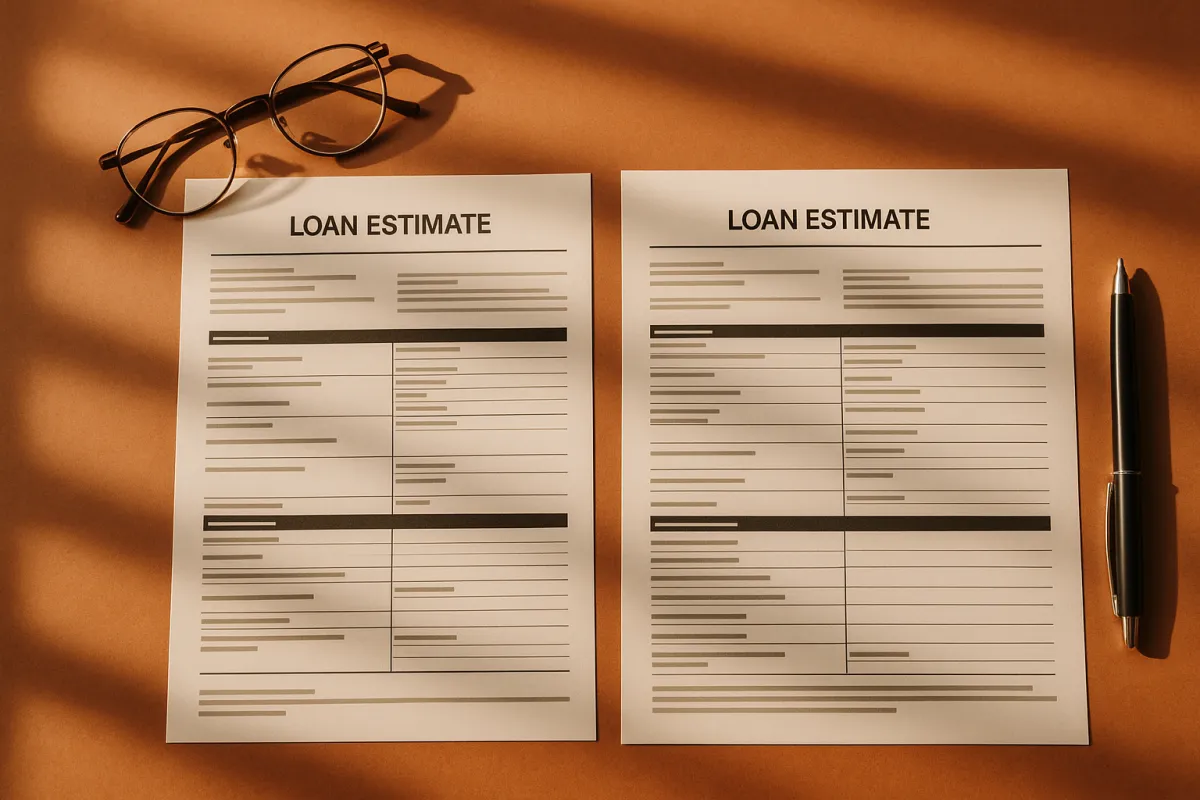
Because scoring models generally treat multiple mortgage inquiries within a short window as a single inquiry, gathering these comparisons costs your credit very little. Line the Loan Estimates up side by side and compare the rate, the APR, and the total closing costs together on each, which the companion calculator on this page can help you translate into an actual dollar difference over the time you plan to keep the loan.
Watch out for gathering quotes over a span of several weeks rather than a short window, since the market itself can move between the first and last quote, muddying whether a difference reflects the lenders or the market. Watch out, too, for a lender who declines to put a verbal number in writing on a real Loan Estimate; a real comparison needs the real document from each side.
Step 7: Decide What to Lock and When
Once you have identified the strongest offer, the final step is deciding when to lock it in. A rate lock freezes your quoted rate for a set period, commonly thirty to sixty days, protecting you from a market move before you close; our rate lock breakdown covers how to choose a length that comfortably covers your closing timeline and what an extension costs if the process runs long.
Locking does not require you to predict where rates go next, and it should not be delayed on a guess about a future drop; once you have a competitive offer that works for your budget, locking it removes one more source of uncertainty from a process that already has plenty. If a rate improvement matters enough to you afterward, refinancing later remains an option once the numbers support it.

Watch out for a lock that is too short for your actual closing timeline, since an expired lock can force an extension fee or leave you exposed to whatever the market offers that day. Watch out, too, for locking before you have actually compared enough quotes to know the offer is competitive; locking a mediocre quote quickly is not better than briefly delaying to compare it against one or two more.
Reading Rates Across Different Loan Types
Everything above focuses on the 30-year fixed rate, since it is the loan type most published averages track, but the same reading skill applies once you branch into other loan types, each of which prices from a different baseline. A 15-year fixed loan typically carries a lower rate than a 30-year on the same day, since the shorter term means less risk for the lender, though the monthly payment is higher because the balance is repaid faster; our 15-year versus 30-year mortgage breakdown runs the trade-off in full.
An adjustable-rate mortgage often starts below the equivalent fixed rate, sometimes noticeably so, but that initial rate is not the whole story, since it resets periodically based on a market index plus a lender’s margin once the initial period ends, covered in our ARM versus fixed-rate mortgage breakdown. Reading an adjustable rate correctly means asking about the reset schedule and the rate caps, not just the attractive introductory number. A jumbo loan, above the conforming loan limit for its area, can price above or below a conforming rate depending on the lender and current market appetite for larger loans, which our jumbo loan breakdown covers if your loan amount is likely to cross that threshold.
The practical habit is the same regardless of loan type: identify what baseline a published figure is actually describing, then find out how your specific loan type and term shift you away from that baseline, rather than assuming every rate you see quoted refers to the same product. This is also why comparing a friend’s or family member’s recent rate against your own can mislead you badly if their loan type, term, or timing differed from yours in any of these ways, even if their credit profile was similar to your own.
A Worked Example: Reading Two Quotes on the Same Day
Put the steps together on real numbers. Two lenders quote the same borrower on the same $350,000 loan, both 30-year fixed. Quote A carries an illustrative 6.75% rate with about $4,000 in total closing costs and no points paid. Quote B carries an illustrative 6.5% rate, achieved partly through points, with about $7,000 in total closing costs. Quote A’s principal-and-interest payment runs about $2,270 a month; Quote B’s runs about $2,212 a month, a monthly saving of about $58.
Dividing the extra $3,000 in upfront costs on Quote B by that $58 monthly saving shows a break-even of roughly 52 months, a little over four years. A borrower planning to keep the loan seven years or longer would come out ahead with Quote B by roughly $1,860 over that stretch once the extra upfront cost is recovered; a borrower expecting to move or refinance within two or three years would likely do better with Quote A’s lower upfront cost. Run your own two quotes through the companion calculator on this page to see your own break-even and which offer wins at the number of years you actually expect to hold the loan.
Where the Real Cost Actually Sits
It helps to see where your money actually goes over a real holding period, since a rate-only comparison tends to understate how much interest, not fees, decides your total cost. The chart below splits the total cash outlay on Quote A over the worked example’s seven-year hold into principal, interest, and upfront fees.
Where a 7-year cash outlay actually goes, Quote A
Illustrative split of total cash paid over 7 years on the worked example's Quote A: a $350,000 loan at 6.75%, with $4,000 in upfront fees.
Illustrative split on the worked example's numbers only. Your own rate, loan amount, and holding period will change this split.
Notice how small the upfront fees are next to the interest paid over even a moderate holding period. That is exactly why the rate difference between two quotes usually matters more than the fee difference over any holding period longer than a few years, and why a slightly higher upfront cost for a meaningfully lower rate is so often the better trade for a borrower who expects to stay in the loan a while. A borrower who expects to move within a year or two, on the other hand, may never reach the point where the lower rate has repaid the extra upfront cost at all, which is exactly the kind of question the break-even math above is built to answer honestly rather than by instinct.
Common Mistakes When Reading a Current Rate
A handful of habits reliably lead to a misread rate.
- Treating a survey average as a personal quote. A published national average describes the broad market, not what a specific lender will offer a specific borrower. Use it for context, not as an expectation for your own Loan Estimate.
- Comparing rates without comparing points. A lower rate achieved through paid points is not directly comparable to a no-points rate; compare the full cost, upfront and monthly, together.
- Ignoring the APR. A rate that looks attractive alone can hide higher fees that the APR would reveal immediately. Read both numbers on every quote.
- Stopping at one quote. A single number, however good it sounds, cannot tell you whether it is competitive without something to compare it against.
- Assuming an advertised rate applies to you. Advertised rates commonly assume a specific strong-credit profile; ask directly whether your own file qualifies for the number shown.
- Confusing today’s average with your closing-day rate. A rate you locked weeks ago and a rate published today are two different numbers describing two different moments; do not compare an old locked rate against a fresh headline and conclude something has gone wrong.
- Skipping the fine print on a headline figure. A rate shown with a small footnote about points, assumed credit score, or a specific loan amount is telling you exactly why the number may not match your own quote; read that footnote before anchoring on the headline.
Troubleshooting Your Rate Reading
A few situations come up often enough to address directly. What if two live sources show different current averages on the same day? Different providers use different methodologies and sometimes slightly different survey windows, so a small gap between sources is normal; use either as general context rather than expecting them to match exactly.
What if a lender’s quoted rate looks much better than everything you have seen published? Ask specifically what assumptions produced that number, credit tier, points, loan amount, and confirm it in writing on a real Loan Estimate before treating it as reliable, since an unusually attractive number sometimes reflects a different, less favorable set of terms than it first appears to.
What if my credit score changes between when I first check rates and when I actually apply? Your quote can shift accordingly, in either direction, since the rate is tied to your file at the time of application, not to an earlier estimate. Re-check your credit and re-request quotes close to when you actually plan to apply if meaningful time has passed since your first look.
What if I already locked a rate and now see a lower published average? A locked rate is a contractual protection tied to your specific closing timeline, not a running comparison against the daily market; if the published average has genuinely fallen enough to matter, ask your lender whether a float-down applies to your lock or whether re-shopping and starting over would be worth the cost of losing your current lock, rather than assuming the lower headline is automatically available to you.
What if a lender’s quoted rate keeps changing between conversations? Rates are priced continuously against a moving bond market, so a quote given verbally one day is not a promise for the next day unless it is formally locked. Ask specifically whether a number you are given is locked or simply an estimate as of that moment, since the two carry very different reliability.
Your Rate-Reading Checklist
Work through this list every time you encounter a mortgage rate you need to actually understand.
- Identify the source. Is this a survey average, an advertised assumption, or a real personal quote? Each means something different.
- Check a live source for today’s average. Use it as market context, not as your expected personal number.
- Know your own five factors. Credit, loan-to-value, debt-to-income, loan type and term, and points paid all move your quote away from any average.
- Request a real Loan Estimate. Only a real quote, tied to your verified file, actually applies to you.
- Read the rate, APR, and points together. A rate alone hides too much; the three together tell the real story.
- Gather at least two or three comparable quotes. One quote cannot tell you whether it is competitive on its own.
- Decide your lock timing deliberately. Lock once you have a workable offer rather than waiting on a guess about the future.
Run any two quotes you gather through the companion calculator on this page to see the real break-even and total cost before you decide, and revisit this checklist the next time a headline rate catches your attention, since the habit of reading a number correctly matters just as much the second and third time as it did the first.
The Bottom Line
Reading a current mortgage rate correctly starts with knowing what the number in front of you actually represents: a survey average, an advertised assumption, or your own real quote, each of which means something different. From there, know the five factors that move your personal number away from any published average, request a real Loan Estimate, read the rate and the APR together, compare multiple quotes on identical terms, and lock once you have an offer that works rather than waiting on a prediction. No specific current rate is stated in this rundown, since it changes constantly; check a live source for today’s average and get a real quote for the number that actually applies to you, then run it through the companion calculator on this page and the full break-even calculator to see it in real dollars.
This rundown is educational only and is not financial, mortgage, or legal advice. No specific current mortgage rate is stated anywhere in this rundown, since any such figure would be stale within days of publishing; all rate and fee figures used in the worked example and the charts are illustrative and chosen to teach the comparison method, not to represent an actual market number. Confirm today’s actual rate and your own personal quote with a live source and a licensed mortgage lender before making any decision.
Frequently asked questions
What does a current mortgage rate table actually show me?
Most rate tables and news headlines show a national or regional average, most commonly the 30-year fixed rate from a survey such as Freddie Mac's, which is a useful benchmark for the general market but is not a quote any specific lender is offering you personally. Some lender websites show a rate specific to an assumed strong-credit borrower with a large down payment, which can look better than what a different borrower would actually be offered. Read any table as context for the market, not as the number you should expect on your own Loan Estimate.
Why is the APR different from the interest rate on a mortgage quote?
The interest rate, sometimes called the note rate, is the percentage used to calculate your principal-and-interest payment. The APR folds in many, though not all, of the loan's upfront fees and expresses the whole package as a single annualized rate, which is why the APR is almost always higher than the note rate on the same quote. Comparing APR alongside the note rate helps you see whether a lower rate is genuinely cheaper or is being paired with higher fees that a rate-only comparison would miss.
Why do two lenders quote different rates for the same borrower on the same day?
Lenders price the same borrower differently based on their own cost of funds, their target profit margin, current pipeline volume, and how aggressively they want to compete for a given loan type that day. None of this reflects your creditworthiness changing between quotes; it reflects real, ordinary variation in how lenders price the same risk. That variation is exactly why gathering multiple quotes on the same day, on the same loan terms, tends to turn up a genuinely better offer rather than confirming that all lenders quote the same number.
How much does my credit score actually change the rate I am quoted?
Meaningfully, though the exact tiers and the size of the gap between them are set by each lender and each loan program and change over time, so no fixed number holds universally. In general, moving from a weaker credit band into a stronger one can shift a quote by a noticeable fraction of a percentage point, sometimes more, which is real money over a 30-year term. Ask any lender you are shopping what tier your specific score falls into and what the next tier up would require, rather than assuming a generic number applies to your file.
Should I trust a rate I see advertised on a lender's website?
Treat an advertised rate as a starting point for a conversation, not a guaranteed personal quote, since advertised rates commonly assume a strong-credit borrower, a specific loan amount, a specific down payment, and sometimes discount points paid upfront that are not always disclosed prominently next to the headline number. Ask the lender directly what assumptions produced the advertised rate and whether your own file would actually qualify for it before treating it as the number you will receive.
What is the fastest way to know if a quote is actually good?
Get at least two more quotes on the exact same loan amount, term, and points assumption, then compare the rate, the APR, and the total closing costs on each Loan Estimate side by side. A single quote, however good it sounds, tells you almost nothing about whether it is competitive; only a real comparison against other real quotes answers that question, and gathering a few quotes within a short window has little effect on your credit.
Does a lower rate always mean a better deal?
Not automatically. A lower rate paired with higher points or fees can cost more overall than a slightly higher rate with lower fees, depending on how long you keep the loan, since points and fees are a fixed upfront cost while the rate difference accumulates gradually every month you hold the loan. Compare the total cost over how long you actually expect to keep the loan, not the rate in isolation, to see which quote genuinely costs less for you.

Hamza Hai is the editor of RefiNook. She holds an MBA and reviews the site's articles against our editorial standards, checking that every figure is labelled for what it is, that nothing is presented as verified fact without a source the reader can check, and that the writing stays useful to a non-specialist.