

What's on this page
- What a Loan Estimate is and why it matters
- Before you start
- Step 1: Check the basics first
- Step 2: Read the projected payments and whether they can change
- Step 3: Understand the monthly payment, PMI, and escrow
- Step 4: Scrutinize the closing costs in Sections A through E
- Step 5: Read the Cash to Close and its calculation table
- Step 6: Compare Loan Estimates from multiple lenders
- Step 7: Spot the red flags before you sign
- The sections of a Loan Estimate at a glance
- A worked example, comparing two Loan Estimates
- Where your closing costs come from
- Common mistakes reading a Loan Estimate
- Troubleshooting your Loan Estimate comparison
- Your Loan Estimate reading checklist
- The bottom line
Short answer: Read a Loan Estimate in the order the form is built: check the basics on page one, read the projected payments and whether they can change, understand the monthly payment with PMI and escrow, scrutinize the closing costs in Sections A through E, follow the Cash to Close table, compare estimates from multiple lenders on APR and total cost over the years you will keep the loan, then spot red flags before you sign.
A Loan Estimate is the most useful document in the entire mortgage process, and most borrowers glance at the rate on page one and skip the rest. That is exactly backward. The form exists to let you compare offers honestly, and by the end of this rundown you will be able to read every section of it, pull out the numbers that decide which loan is truly cheaper, and spot the fees that a low advertised rate quietly hides. The skill is not complicated; it is a matter of reading the pages in the right order and knowing what each section is telling you.
Here is why this matters in dollars. Two lenders can quote the same buyer very different deals, and the one with the lower rate is not always the cheaper loan once the closing costs are counted. A Loan Estimate is standardized, meaning every lender uses the same three-page layout with the same sections in the same order, so two estimates line up perfectly for comparison. This rundown walks the form page by page, then shows you how to compare two of them apples to apples. For the wider cost picture behind these forms, our cost to refinance a mortgage breakdown is worth a look, and you can compare two offers in about a minute with the companion calculator on this page.
Key takeaways
- A Loan Estimate is a standardized three-page form, so two of them compare section by section; that is the whole point of the document.
- Read it in order: the basics, the projected payments, the monthly payment breakdown, the closing costs by section, and the cash to close.
- Compare offers on the APR and the total cost over the years you will actually keep the loan, not on the advertised rate.
- The single biggest mistake is picking the lower rate while ignoring Section A and the closing costs that erase it.
- On an illustrative $360,000 loan, a lower-rate offer with higher fees can cost more over seven years yet less over thirty; confirm current figures for your own numbers.
What a Loan Estimate is and why it matters
A Loan Estimate is the form a lender must give you after you apply, commonly cited as within three business days, and its job is to make loans comparable. Before this standardized form existed, every lender presented costs differently, and lining up two quotes meant guessing which fee matched which. Now the form is fixed: three pages, the same sections in the same places, so when you hold two estimates side by side, the rate sits above the rate, Section A sits above Section A, and the cash to close sits above the cash to close. That structure is the reason a Loan Estimate is the best comparison tool you have, and it is why reading it properly beats any advertised rate table.
The form has three pages, and each does a distinct job. Page one carries the basics: the loan amount, the interest rate, the monthly principal and interest, whether the rate can change, and a few yes-or-no boxes for features like a prepayment penalty. It also summarizes your projected payments over the life of the loan and your estimated cash to close. Page two breaks the closing costs into labeled sections, from the lender’s own origination charges through the services you can and cannot shop for, and then the taxes, prepaid items, and escrow. Page three holds the comparisons, including the APR and figures that show the loan’s long-run cost, plus other considerations like whether the loan can be assumed or carries late fees.
The important idea before you start is that no single number on the form tells you which loan is cheaper. The rate ignores fees. The fees ignore the term. The monthly payment ignores what you pay upfront. Only by reading the sections together, and then comparing two estimates as a set, do you see the real cost. Every dollar figure in this rundown is illustrative and varies by lender, loan, and location, so confirm your own numbers, but the reading method does not change. Work the pages in order, and the form gives up its answer.
Before you start
Reading a Loan Estimate is a doable task, and it goes faster when you have the right materials in front of you. This is a low-difficulty, high-payoff exercise: the reading itself takes well under an hour, though gathering the estimates to compare can take a few days as lenders respond. Before you work the seven steps, get these things together.
- At least one Loan Estimate, ideally two or more. A single estimate is readable on its own, but the real power of the form is comparison, so aim to have two or three from different lenders covering the same loan amount, term, and product.
- The same loan assumptions on each. For a fair comparison, every estimate should assume the same loan amount, the same term, the same product, and the same points, or the rates are not comparable. Note any that differ.
- A calculator or the companion below. You will convert rates into monthly payments and add up total costs, which is a minute of arithmetic per offer. The companion calculator on this page does it for two offers at once.
- A rough sense of how long you will keep the loan. Whether the cheaper loan is the one with the lower rate or the lower fees depends heavily on how many years you hold it, so have a realistic timeline in mind.
Difficulty here is genuinely low, and the reward is concrete: a clear-eyed answer to which loan costs you less. If you are comparing offers as part of a refinance rather than a purchase, our step-by-step refinance rundown walks that specific path, and the reading method below applies to both. With your estimates in hand and the same assumptions on each, work the steps in order.
Step 1: Check the basics first
Start at the top of page one, because the basics frame everything that follows. Confirm five things before you read another line: the loan amount, the interest rate, the loan term, the loan product, and whether the rate is locked. The loan amount should match what you expect to borrow. The interest rate is the note rate, the cost of borrowing before fees, and it is not the same as the APR you will meet on page three. The term is the length of the loan, commonly thirty or fifteen years, and it drives your payment and your lifetime interest. The product tells you the type, such as a fixed-rate or an adjustable-rate loan, and whether it is conventional or a government-backed program.
Next, look for the small boxes that answer yes or no to whether the rate and the loan features can change. Page one states plainly whether the interest rate is locked, and if it is not, the rate you are reading can move before you close. It also flags, in dedicated boxes, whether the loan carries a prepayment penalty or a balloon payment. These boxes are easy to skim past and expensive to miss, which is why they belong in the very first step rather than buried later.
An illustrative example makes it concrete. Suppose page one shows a $360,000 loan, a 6.50% rate, a 30-year fixed conventional product, and a note that the rate is not yet locked. That single line tells you the loan you are pricing and warns you that the 6.50% could change until you lock it. Watch out for assuming the rate is fixed for your comparison when the form says it is not locked, because comparing an unlocked rate from Monday against a locked one from Friday is not a fair fight. Confirm each of the five basics matches across every estimate you are comparing before you move on, since a mismatch here quietly invalidates everything downstream.
Step 2: Read the projected payments and whether they can change
With the basics confirmed, move to the Projected Payments section on page one, which shows how your payment behaves over the life of the loan. On a fixed-rate loan this may be a single column, because the principal and interest stay level for the whole term. On an adjustable-rate loan it shows more than one column, because the payment can change after the initial fixed period, and the form illustrates a range the payment could reach. Reading this section is how you learn, at a glance, whether the payment you see today is the payment you will have in five or ten years.
The section separates the payment into its parts so you can see what is stable and what is not. The principal and interest portion is set by your rate and term on a fixed loan. Added to it are estimated amounts for mortgage insurance and for escrow, which covers property taxes and homeowners insurance, and those escrow amounts can change over time even on a fixed-rate loan because taxes and insurance premiums move. So the total monthly payment can drift upward even when the rate never budges, and this section is where the form tells you so honestly.
An illustrative read: on our $360,000 loan at 6.50% over thirty years, the principal and interest is roughly $2,276 a month, and the section would add estimated mortgage insurance and escrow on top to show a higher total payment. Watch out for comparing only the principal and interest between two offers while ignoring the escrow and insurance lines, because a lender that estimates escrow low can make a total payment look smaller than it will be. Watch out, too, for an adjustable-rate loan whose first column looks cheap; read the later columns to see what the payment could become once it adjusts, and weigh that against how long you plan to stay.
Step 3: Understand the monthly payment, PMI, and escrow
Now slow down on the monthly payment itself, because the number most buyers fixate on is actually a bundle of four things, often called PITI: principal, interest, taxes, and insurance. Principal and interest is the loan payment set by your rate and term. Taxes means property taxes, and insurance means homeowners insurance, both of which the lender usually collects monthly and holds in an escrow account to pay on your behalf. On top of those, if your down payment is below the lender’s threshold, a conventional loan typically adds private mortgage insurance, or PMI, a premium that protects the lender while your equity is thin. Reading the payment as these parts, rather than one lump, is what lets you compare two offers fairly.
The escrow piece deserves attention because it is not a cost of the loan at all; it is your own tax and insurance bills, collected in monthly installments. Two lenders can show different escrow estimates for the same house simply because they estimated taxes or insurance differently, which changes the total payment without changing the loan. PMI is different again: it is a real added cost driven by your down payment, and it typically falls away once you build enough equity, so it is temporary in a way the other pieces are not. Our rundown on getting rid of PMI walks how and when that premium can come off.

An illustrative breakdown on the $360,000 loan: principal and interest near $2,276, plus perhaps a few hundred dollars of combined taxes and insurance in escrow, plus PMI if the down payment is thin, adds up to a total payment meaningfully above the principal and interest alone. Watch out for reading the headline payment as if it were all principal and interest, because the escrow and PMI can add a large share. Watch out, too, for assuming PMI is permanent; knowing it can drop off later changes how you weigh two offers. Separate the payment into its parts, and you compare loans, not estimates of your tax bill.
Step 4: Scrutinize the closing costs in Sections A through E
Turn to page two, which breaks your closing costs into labeled sections, and this is where two estimates most often diverge. The form groups the loan costs first. Section A is Origination Charges, the lender’s own fees, which can include points and application or underwriting fees, and it is often the most negotiable part of the whole form. Section B is Services You Cannot Shop For, such as an appraisal the lender orders and a credit report, which you must accept as the lender arranges. Section C is Services You Can Shop For, such as title and settlement services, where choosing your own provider can genuinely lower the cost. Together, Sections A, B, and C make up your loan costs.
Below the loan costs come the other costs. Section E is Taxes and Government Fees, such as recording fees and any transfer taxes, which are set by public authorities and are largely fixed. The form continues into prepaid items and initial escrow in the sections that follow, but Sections A through E are where you spend your scrutiny, because that is where a lender’s choices, and yours, show up. The reason the form separates these is precisely so you can see what you control: Section A is the lender asking, Section C is you shopping, and Section E is the government charging.
An illustrative Section A might show $2,400 of origination charges, Section B around $1,200 of unavoidable lender-ordered services, and Section C about $1,800 of shoppable services. Watch out for a large Section A, since a high origination charge is the classic way a lender offsets a low advertised rate, and it is also the most negotiable line, so it deserves a direct question. Watch out, too, for accepting Section C at the lender’s suggested providers without checking whether you can do better; those are, by name, services you can shop for. Reading these sections is how you separate a genuinely cheap loan from one that moved the cost from the rate into the fees.
Step 5: Read the Cash to Close and its calculation table
Next, find the Cash to Close figure and the small table that calculates it, because this is the number that tells you what you must actually bring to closing. Cash to Close is not the same as your closing costs; it is the full amount of money due, which combines your down payment, your total closing costs, and prepaid and escrow items, minus any credits such as a lender credit or a deposit you already paid. For most buyers the down payment is the largest single piece, which is why the cash to close dwarfs the closing costs alone, and why reading only the closing-costs line understates how much cash you need.
The Loan Estimate shows a Calculating Cash to Close table that walks through the arithmetic line by line, from the total closing costs, through the down payment and any deposit, to any adjustments and credits, arriving at the final figure. Reading that table is how you understand the number rather than just accepting it, and it is how you catch a lender credit that lowers your upfront cash in exchange for a higher rate, which is a trade you want to see clearly rather than stumble into. The table exists so the final number is never a mystery.
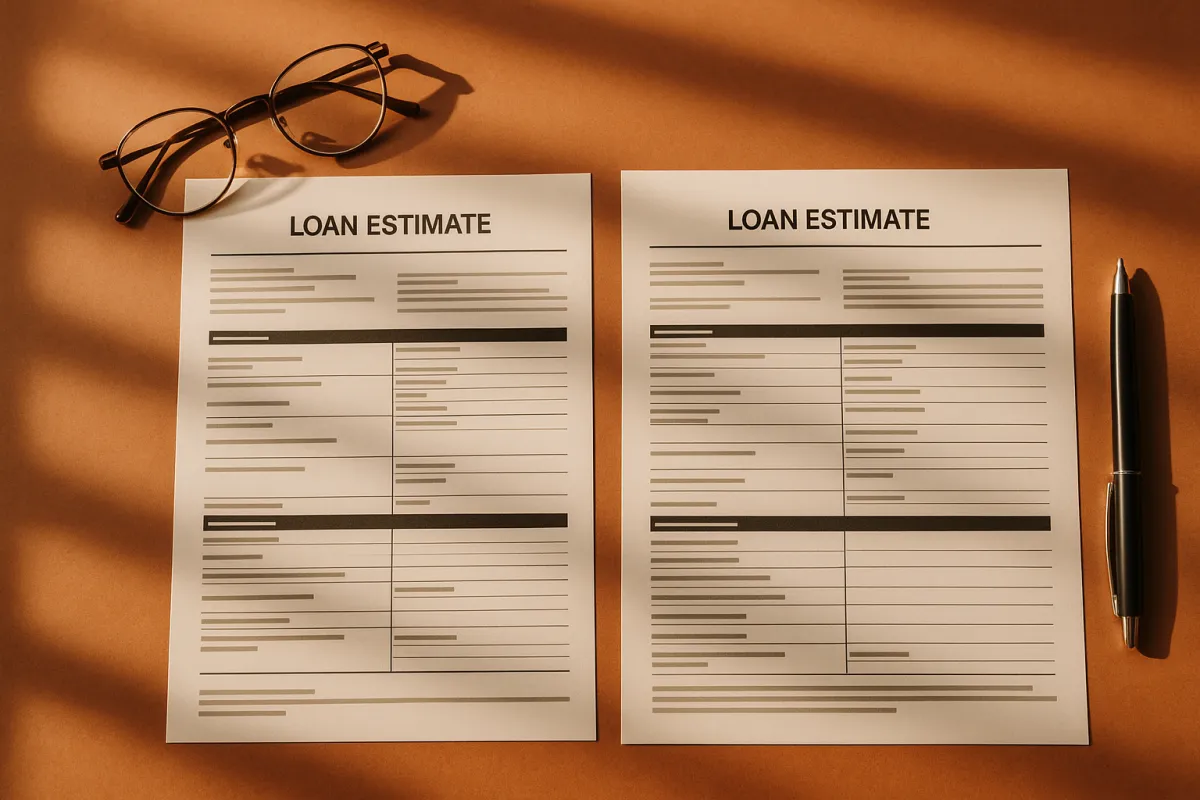
An illustrative walk: suppose total closing costs are $12,000, your down payment is a set amount, and a deposit and a small lender credit reduce the total; the table subtracts and adds each piece to land on your cash to close. Watch out for a lender credit that makes the cash to close look attractively low, because that credit is usually paid for with a higher rate, so it can cost you more over time even as it costs you less on closing day. Watch out, too, for comparing two offers on cash to close alone; a lower cash to close paired with a higher rate can be the more expensive loan across the years you keep it, which is exactly the trade the next step untangles.
Step 6: Compare Loan Estimates from multiple lenders
Here is where the standardized form earns its keep: comparing two or more estimates side by side. Because the layout is identical, you can lay the estimates out and read across, rate against rate, Section A against Section A, cash to close against cash to close. Do this with the same loan amount, term, and product on each, or the comparison is not fair. The discipline is to resist ranking the offers by the one number that first catches your eye, usually the rate, and instead read them as complete packages, since the cheapest rate and the cheapest fees rarely sit on the same estimate.
The single most useful comparison number is on page three: the APR, or annual percentage rate, which folds many of the closing costs into a rate-like figure so two offers become comparable in one number. A loan with a lower note rate but much higher costs can carry a higher APR, and that is the signal that its fees have eaten the rate advantage. The catch, which the next step and the worked example both stress, is that APR generally assumes you hold the loan for its full term, so it can mislead if you plan to leave early. Our rundown on getting the best mortgage rate covers how to gather several estimates in a short window so your credit barely notices, which is what makes this comparison practical.

An illustrative comparison: Loan A quotes 6.75% with $6,000 in costs, while Loan B quotes 6.50% with $12,000 in costs. The lower rate is Loan B, but it charges $6,000 more upfront, so which is cheaper depends entirely on how long you keep it. Watch out for the instinct to hand the win to the lower rate; on these numbers that instinct can be wrong for a buyer who moves in a few years. Watch out, too, for comparing estimates gathered weeks apart, since rates move and an old estimate may no longer be available. Gather them close together, compare the whole package, and let the total cost decide.
Step 7: Spot the red flags before you sign
The last step is a deliberate sweep for red flags, because a Loan Estimate can be perfectly standardized and still describe a loan you should question. Four warning signs deserve a direct look. First, an unusually high Section A origination charge, which can mean the lender is offsetting a low rate with upfront fees; it is negotiable, so ask. Second, junk or padded fees, meaning charges that look inflated or duplicated across the cost sections; the form’s labels help you see whether a fee belongs where it sits. Reading these against a second estimate is the fastest way to spot one that is out of line.
Third, and this is the box people miss, a prepayment penalty. Page one has a specific yes-or-no box telling you whether the loan charges a fee if you pay it off early, whether by selling, refinancing, or paying it down fast. If that box says yes, a low rate can come with a costly string attached, so it changes the comparison entirely. Fourth, a balloon payment, which is a single large amount due at the end of the term rather than a loan that fully pays off through level payments; it too has its own box, and it means the loan does not amortize the way most buyers assume. Neither feature is automatically disqualifying, but both change the math and your flexibility.
An illustrative red-flag check: you notice Loan B’s Section A is high, confirm the prepayment-penalty box reads no, and check that no fee looks duplicated; the loan passes. Watch out for treating a low rate as proof a loan is safe, because the rate says nothing about a prepayment penalty or a balloon feature. Watch out, too, for skipping the yes-or-no boxes on page one because they are small; they carry some of the most consequential information on the form. Sweep for these before you sign anything, and confirm each one on the later Closing Disclosure as well, since that is your final chance to catch a change.
The sections of a Loan Estimate at a glance
Before the worked example, it helps to see how the closing-cost sections stack up on a single illustrative estimate, because the sizes tell you where to spend your scrutiny. The chart below shows the six cost sections of an illustrative $12,000 estimate in dollars, in the order they appear on page two. The origination charges, the prepaids, and the initial escrow are the largest here, while the lender-ordered services you cannot shop for are the smallest. These figures are illustrative and vary by lender, loan, and location, so treat them as a map of the form rather than a promise, and confirm your own numbers.
The sections of a Loan Estimate at a glance
Illustrative dollar size of each closing-cost section on a $12,000 estimate, in page-two order.
Section A is where the lender's own charges sit and where negotiation helps most; Section C is where your own shopping helps. Sizes are illustrative and vary by lender.
The lesson of the chart is not that any one section is always largest, but that the form separates them so you can see which you can move. Section A and Section C, the origination charges and the services you can shop for, are the two places your effort changes the number, so a large bar there is an invitation to ask or to shop. The taxes, prepaids, and escrow are larger on this illustrative estimate yet harder to move, because third parties set them. Knowing which bars you can push and which you cannot is what turns reading the form into saving money.
A worked example, comparing two Loan Estimates
Put the seven steps together on two illustrative estimates for the same $360,000 loan on a 30-year fixed product. Loan A quotes a 6.75% rate with $6,000 in total closing costs. Loan B quotes a 6.50% rate with $12,000 in total closing costs. Read the basics on each and they match on amount, term, and product, so the comparison is fair. The rates differ by a quarter of a percent, and the costs differ by $6,000, so this is the classic case where the lower rate carries higher fees, and the rate alone cannot tell you which loan is cheaper. All figures here are illustrative, and current rates should be confirmed with lenders.
Convert each rate to a monthly principal and interest payment. On the $360,000 loan over thirty years, Loan A at 6.75% is roughly $2,335 a month, and Loan B at 6.50% is roughly $2,276 a month, a difference of about $60 a month in Loan B’s favor. So Loan B saves you about $60 every month but charges $6,000 more upfront. The question is how many months of that $60 saving it takes to repay the extra $6,000, which is a break-even: about $6,000 divided by about $60 a month is roughly 100 months, or a little over eight years. Before that point, the cheaper upfront loan wins; after it, the lower-rate loan pulls ahead.
Now run the total cost two ways. Over seven years, which is 84 months, Loan A costs about its $6,000 in fees plus $2,335 a month, while Loan B costs about its $12,000 plus $2,276 a month; adding those, Loan A comes out cheaper by roughly $1,000 across the seven years, because you leave before the break-even. Over the full thirty years, the picture flips: Loan B’s lower rate compounds, and it comes out cheaper by roughly $15,000. This is exactly why the APR, illustratively around 6.9% for Loan A and around 6.7% for Loan B, ranks Loan B cheaper: APR assumes you hold the loan the full term. If your real timeline is seven years, Loan A is the cheaper loan even though it has the higher rate and the higher APR. Run your own two offers through the companion calculator on this page to see which wins over the years you will actually keep the loan.
Where your closing costs come from
The worked example turned on $6,000 of extra costs, so it is worth seeing where closing costs come from in terms of how much control you have over them. The chart below splits the same illustrative $12,000 estimate into three buckets by who sets the number: the shoppable and negotiable charges you can influence, the fixed lender-required services you cannot shop for, and the third-party and unavoidable items like taxes, prepaids, and escrow. The split shows that a little over a third of these illustrative costs are ones you can actually move, which is where your effort belongs.
Where your closing costs come from
Illustrative split of a $12,000 estimate by how much control you have over each part.
The shoppable and negotiable share, Sections A and C, is where asking and comparing change the number. Shares are illustrative and vary by lender and location.
The point of the split is to aim your effort. More than half of these illustrative costs are set by third parties, taxes, prepaid interest, and the initial escrow your own tax and insurance bills fund, and no amount of negotiation moves those much. A small slice is fixed lender-required services. But the third you can influence, the origination charges in Section A and the shoppable services in Section C, is exactly where comparing two estimates and asking a direct question can lower your cash to close. So when two offers differ, look first at those sections, because that is where the difference is both real and movable.
Common mistakes reading a Loan Estimate
A handful of predictable errors turn a clear comparison into a costly guess. Recognizing them is often worth more than any single fee you might negotiate.
- Comparing the rate instead of the total cost. The advertised rate ignores fees and the term. A lower rate with higher costs can be the more expensive loan over the years you keep it, so compare the APR and the total cost, not the headline rate.
- Ignoring Section A. The origination charges are the lender’s own fees, often the largest movable cost and the most negotiable, yet they are easy to skim past. A high Section A is frequently how a low rate is paid for, so read it and ask about it.
- Not shopping Section C. These are, by name, services you can shop for, such as title and settlement. Accepting the lender’s suggested providers without checking whether you can do better leaves money on the table.
- Missing the prepayment-penalty box. The small yes-or-no box on page one can mean a fee for paying the loan off early, which changes the whole comparison. Skipping it because it is small is exactly how it bites.
- Letting estimates expire. A Loan Estimate is honored for a limited window, and rates move day to day. Gathering one estimate now and another weeks later means comparing numbers that may no longer be available, so collect them close together.
Each of these traces back to reading one number in isolation instead of the form as a whole and the two forms as a set. The borrowers who choose the cheaper loan are simply the ones who read every section and compare the complete package before they commit.
Troubleshooting your Loan Estimate comparison
Even a careful read can hit a snag. Here is how to think through the common ones.
What if I only have one Loan Estimate? A single estimate is still readable, and the seven steps all apply, but you lose the comparison that gives the form its power. Without a second estimate, you cannot tell whether the origination charges in Section A or the services in Section C are competitive, since you have nothing to read them against. The fix is to gather at least one more, ideally two, on the same loan amount, term, and product. If that is not possible right now, at least confirm the basics, check the prepayment and balloon boxes, and read the APR, then treat the offer as a baseline rather than a proven-best deal.
What if the costs changed at closing? Some figures on a Loan Estimate are allowed to change within limits, and some are generally expected to hold, which is why you receive a separate Closing Disclosure before you sign. Compare the two line by line: the lender’s own charges and the services you were not allowed to shop for are the ones that should not jump, while prepaid interest and items you chose can move somewhat. If a figure that was supposed to hold has changed, that is a question to raise with the lender before closing, not a surprise to accept after.
What if there is a seller or lender credit? A credit reduces the cash you bring to closing, and it appears in the Calculating Cash to Close table so you can see it. A seller credit is money the seller agreed to put toward your costs, while a lender credit usually comes in exchange for a higher rate. Both lower your upfront cash, but the lender credit has a long-run cost baked into the rate, so read what you are trading. Follow the table line by line and you will see exactly what each credit does to your cash to close and, in the case of a lender credit, what it costs you in rate.
What if the points are confusing me? Points, sometimes called discount points, are an upfront charge that buys a lower rate, and they can make two estimates hard to compare if one includes them and the other does not. The fix is to make sure each estimate assumes the same points, or to note the difference explicitly and compare the total cost, including the points, over your timeline. Our rundown on whether mortgage points are worth it walks the break-even math, which is the same logic as choosing between a lower rate and lower fees.
Your Loan Estimate reading checklist
Before you choose a lender, work through these in order. Save this list and tick each box.
- Confirm the five basics. Check the loan amount, rate, term, product, and whether the rate is locked, and make sure they match across every estimate you compare.
- Read the projected payments. See whether the payment can change, especially on an adjustable-rate loan, and read the escrow and insurance lines, not just principal and interest.
- Break the monthly payment into PITI and PMI. Separate principal and interest from taxes, insurance, and any PMI, so you compare the loan rather than the tax estimate.
- Scrutinize Sections A through E. Question a high Section A, shop Section C, and note that Section E is largely fixed by the government.
- Read the Cash to Close table. Follow the calculation line by line, and watch for a lender credit that lowers upfront cash in exchange for a higher rate.
- Compare estimates on APR and total cost. Lay them side by side, compare the APR, and compute the total cost over the years you will actually keep the loan.
- Sweep for red flags. Check the prepayment-penalty and balloon boxes, question padded fees, and confirm each red flag again on the Closing Disclosure.
Run your two offers through the companion calculator on this page to see which is cheaper over your real timeline before you commit.
The bottom line
A Loan Estimate is standardized for one reason: so you can read it and compare it. Work the pages in order, confirm the basics, understand how the payment is built from principal, interest, taxes, insurance, and any PMI, scrutinize the closing costs by section, and follow the cash to close through its own table. Then lay two estimates side by side and let the APR and the total cost over your real timeline decide, not the advertised rate. As the worked example showed, the lower rate can be the cheaper loan over thirty years yet the more expensive one over seven, so the winner depends on how long you keep it. Read the whole form, compare the complete package, and check the red-flag boxes before you sign. Confirm current figures for your own numbers, and let the full estimate, not the headline rate, choose your loan.
One honest note before you begin: this rundown is educational only, not mortgage, financial, or legal advice, and it cannot read your Loan Estimate the way a licensed professional can. Every rate, payment, fee, and percentage in it is illustrative, so confirm current figures with lenders and read your own estimates line by line, since costs and rules change and each lender fills in the form differently. Which loan is cheaper depends on your loan amount, your closing costs, and how long you actually keep the loan, none of which this rundown can know. A prepayment penalty, a balloon feature, a lender credit, and points all carry trade-offs specific to your situation. Compare your own estimates, then have a licensed mortgage professional review the specifics before you commit to a loan.
Frequently asked questions
What is a Loan Estimate and when do I get one?
A Loan Estimate is a standardized three-page form a lender must give you, commonly cited as within three business days of receiving your application, that lays out the loan's rate, projected payments, and closing costs in a fixed format. Because every lender uses the same form with the same sections in the same order, it is the single best tool for comparing offers, since two estimates line up section by section. Treat it as the document that turns a vague quote into a comparable one. The exact timing and rules can change, so confirm the current requirements, but the purpose is constant: to let you see and compare the full cost of a loan before you commit.
Is the interest rate or the APR the better number to compare?
For comparing two offers, the annual percentage rate, or APR, is usually the more complete single number, because it folds many of the closing costs into a rate-like figure, while the note rate shows only the cost of borrowing before fees. A loan with a lower rate but much higher costs can carry a higher APR, which is the signal that its fees erase the rate advantage. The important caveat is that APR generally assumes you keep the loan for its full term, so if you plan to move or refinance in a few years, APR can overstate the benefit of paying more upfront. Compare the APR, but also compare the total cost over the years you will actually hold the loan.
What does Cash to Close mean on a Loan Estimate?
Cash to Close is the total amount of money you need to bring to the closing table, and it combines your down payment, your closing costs, and any prepaid or escrow items, minus any credits such as a lender credit or a deposit you already paid. It is not the same as your closing costs alone, because it also includes the down payment, which is the largest piece for most buyers. The Loan Estimate shows a small table that walks through how the figure is calculated, so you can see exactly what makes it up. Reading that table line by line is how you avoid a surprise about how much cash you actually need on closing day.
Which closing costs can I actually shop for or negotiate?
The Loan Estimate separates costs into sections precisely so you can see what you control. Section A holds the lender's own origination charges, which are often the most negotiable. Section B lists services you cannot shop for, such as an appraisal the lender orders. Section C lists services you can shop for, such as title and settlement services, where choosing your own provider can lower the cost. Sections E, F, and G cover taxes, government fees, prepaid items, and initial escrow, which are largely set by third parties and are harder to move. Focus your effort on Sections A and C, since those are where asking or shopping can genuinely change the number.
How long is a Loan Estimate good for?
A Loan Estimate typically states that the interest rate is not locked and that the estimate of costs is honored for a limited window, commonly cited illustratively as about ten business days, after which the lender is not bound to the same figures. That window matters when you are comparing offers, because if you take too long to decide, the numbers you were comparing may no longer be available. Rates themselves can move day to day even inside that window unless you lock. The practical lesson is to gather your estimates close together and decide while they are all still current, rather than collecting one now and another weeks later.
Why are the closing costs on two Loan Estimates so different?
Two estimates for the same loan can differ mainly in Sections A and C, because those hold the lender's own charges and the services you can shop for, which genuinely vary between lenders. The third-party and government items in Sections E through G tend to be more similar, since they reflect taxes, recording fees, and prepaid amounts that are set outside the lender's control. A lower rate paired with much higher costs, or the reverse, is common, which is why comparing only the rate misleads. Line the estimates up section by section, and the differences that matter, and the ones you can influence, become clear.
Can the numbers on my Loan Estimate change before closing?
Some can and some cannot, which is a core reason the form is standardized. Certain figures, such as the lender's own charges and services you were not allowed to shop for, are generally expected to stay the same, while others, such as prepaid interest or costs for services you chose, are allowed to change within limits. Before you sign, you receive a separate Closing Disclosure that shows the final numbers, and comparing it against your Loan Estimate line by line is how you catch a change that should not have happened. If a figure that was supposed to hold has jumped, that is a question to raise before closing, not after.
What is a prepayment penalty and where is it on the form?
A prepayment penalty is a fee some loans charge if you pay the loan off early, whether by selling, refinancing, or making large extra payments, and it can quietly cost you if you expect to do any of those. The Loan Estimate has a specific yes-or-no box on its first page that tells you whether the loan carries one, which is why reading that box is part of checking the basics. A balloon payment, a single large amount due at the end of the term, has its own box nearby. Neither is automatically disqualifying, but both change the math and your flexibility, so you want to know they are there before you compare an offer on rate alone.
How do I compare a mortgage refinance estimate from two lenders?
A refinance Loan Estimate reads exactly like a purchase one, so the same section-by-section method compares mortgage loan offers side by side: line up the interest rate, the APR, and the total closing costs across Sections A through E, and pay special attention to Sections A and C, where the lender's own charges and the shoppable services differ most. On a refinance the comparison carries one extra layer, because the point of the loan is usually to save money, so the estimate that matters is not simply the one with the lowest closing costs but the one whose monthly saving repays those costs within the time you will stay in the home. The companion on this page compares two offers on total cost over the years you plan to keep the loan, which is the honest way to rank refinance estimates. Treat every figure as illustrative and confirm the current numbers with each lender, since an estimate is honored only for a limited window.

Hamza Hai is the editor of RefiNook. She holds an MBA and reviews the site's articles against our editorial standards, checking that every figure is labelled for what it is, that nothing is presented as verified fact without a source the reader can check, and that the writing stays useful to a non-specialist.